On or near this date, Lewis and the Mandan delegation arrive at Abingdon, Virginia. In 1806, the town was prospering and a popular layover for travelers on the Great Wagon Road.[1]Traveling with Meriwether Lewis to Washington City is a Mandan delegation from the Knife River Villages—Chief Sheheke, his wife Yellow Corn, and their son. Speaking Mandan and French was … Continue reading
In St. Louis, postmaster and land speculator Rufus Easton writes to President Thomas Jefferson declaring triumph over James Wilkinson and seeking to color any report from Meriwether Lewis and William Clark concerning Antoine Soulard’s Archive of Surveys.
Abingdon, Virginia
Originally called Wolf Hills and later named Black’s Fort in honor of the defense erected to protect the settlers from Indian attacks, the town of Abingdon was officially established in 1778 when 120 acres were given for that purpose. By 1793 the town had prospered and become the clearinghouse for all mail sent to Southwest Virginia. It had also served as the county seat of Washington County when the first court met there in 1777.[2]“Abingdon Historic District”, National Register of Historic Places registration form (Abingdon Virginia), … Continue reading
Abingdon, Virginia (Stylized)
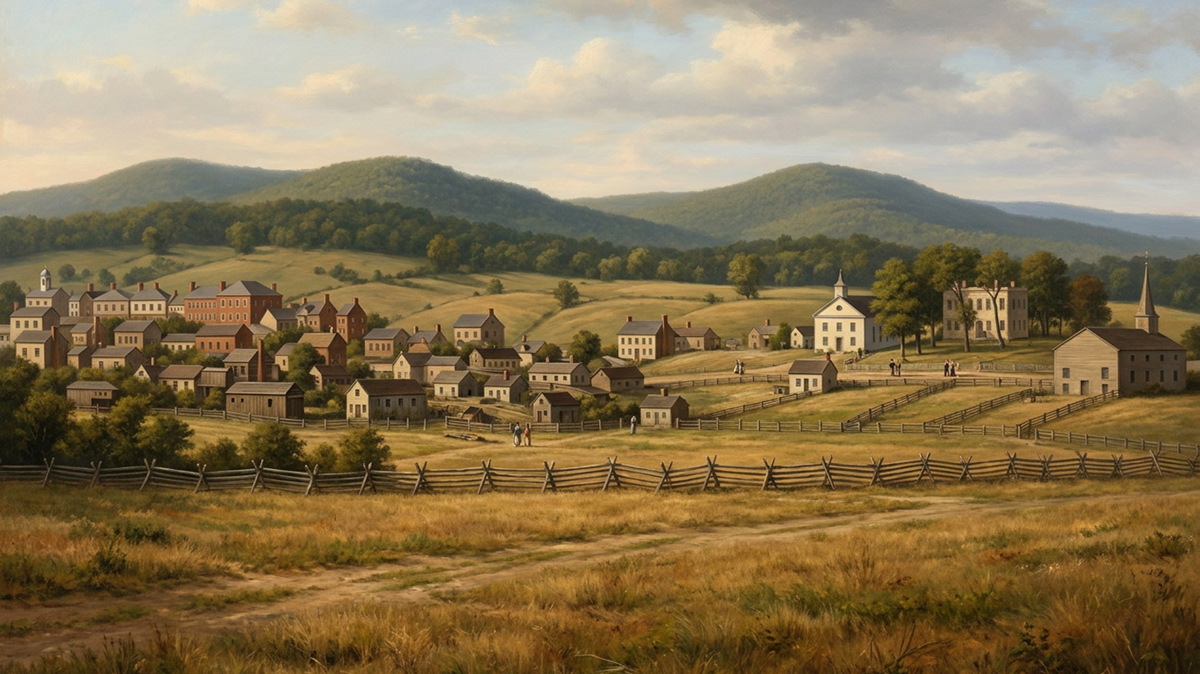
Generated from an original engraving from Henry Howe’s Historical Collections of Virginia (1845). View the original at commons.wikimedia.org/wiki/File:Historical_Collections_of_Virginia_-_Abingdon.jpg.

The story that Daniel Boone named Wolf Hills after wolves attacked his dogs is likely a myth.[3]James William Hagy, History of Washington County, Virginia to 1865 (Missoula, Montana: Pictorial Histories Publishing Company, 2013), 25–27.
William King House
The Great Road, a thoroughfare linking the Valley of Virginia to the interior of North America, passed through Abingdon. Meriwether Lewis and William Clark used this route when returning to the East after their expedition to the Pacific Ocean (1803–06). Lewis, with a group of Native Americans from present-day North Dakota, passed here late in 1806 on his way to report to Pres. Thomas Jefferson. Clark followed separately, reaching Fincastle, VA, in Jan. 1807 to visit his future wife, Julia Hancock. He passed here again on his way from St. Louis for their wedding in Jan. 1808. On an eastward journey in 1809, Clark spent the night of 12 Nov. in or near Abingdon, possibly at the William King House.[4]“6 New State Historical Highway Markers Approved”, The Virginia Department of Historic Resources, 4 October 2023, … Continue reading
William King House, Abingdon, Virginia
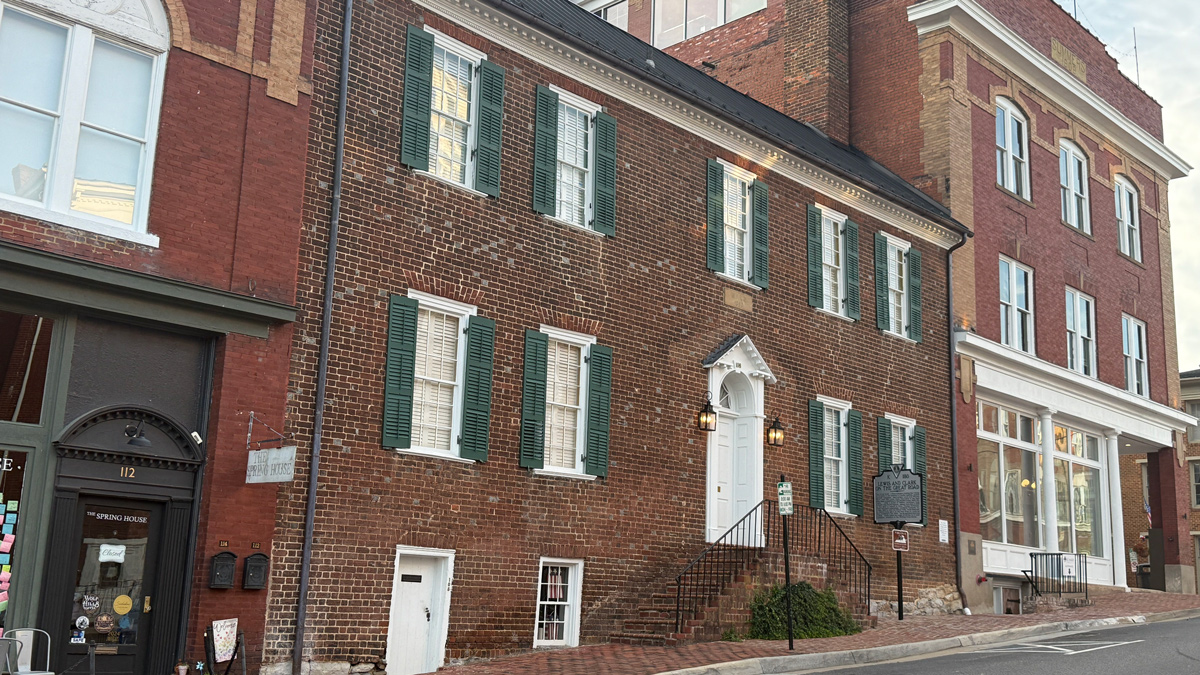
By Tom Bosse, 4 September 2022, submitted to the Historical Marker Database, www.hmdb.org/m.asp?m=305062.
The historic marker transcribed and shown above commemorates Lewis and Clark’s connection to Abingdon. During his lifetime, William King amassed a fortune from his saltworks in Saltville located 18½ miles northeast of Abingdon. Like Lewis, he was a practicing Free Mason. Called “Grace Hill” by his wife, this was the first brick house in Abingdon and the first to have running water. For Lewis and Free Masonry, see Lewis as Master Mason.[5]“Virginia Highlands Festival Holds Historic Home and Buildings Tour”, A! Magazine for the Arts, 33, no. 9 (September 2026), … Continue reading
Easton Triumphs
Miniature of Rufus Easton
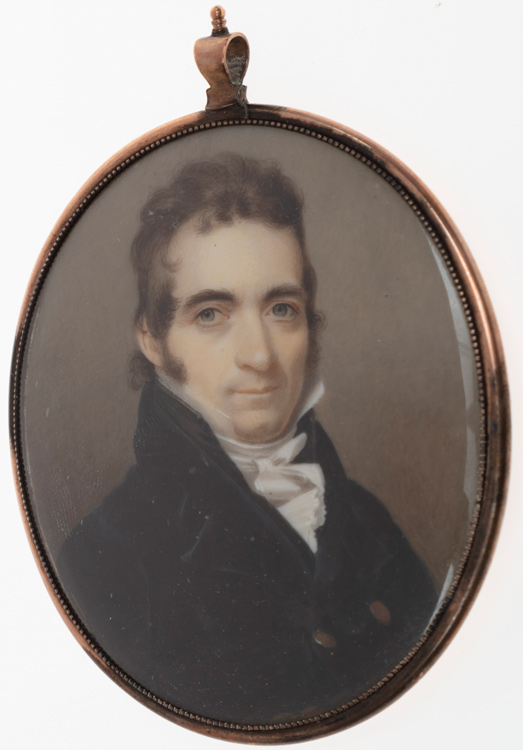
Missouri Historical Society, mohistory.org/collections/item/1950-010-0001.
St. Louis Novr. 29th 1806.
Sir
The confidence and respect heretofore received from you has induced me to write you-‘-The embarrass’d situation into which the load of General Wilkinsons persecutions had placed me, hitherto has prevented my addressing you. I have triumphed over Wilkinson and surmounted (tho’ with the loss of office) these persecutions.
. . . . .
It is fortunate for me however that the Books & Records of Soulard have been personally inspected by Captains Lewis & Clark, who will be the faithful messengers of their state & condition, and that they contain innumerable alterations & forgeries!—added to this the principal deputy surveyor (than whom a more honest Man liveth not) has reported them officially as “evidence only of fraud and deceit,” so that instead of the “falshood of my report” the truth of it will be established, to the exclusion of the Interest made in favor of the “amiable and chaste Soulard.”
. . . . .
Accept my Salutations & Respect,
R: Easton[6]Clarence E. Carter, The Territorial Papers of the United States (Washington, DC: United States Government Printing Office, 1949), 14:44–46, digitized by Google books.
In St. Louis, Rufus Easton was a lawyer, postmaster, and sometimes land speculator. In 1806, he became entangled in the controversies surrounding Spanish Land grants. So much so that in June 1806, he stormed into a Land Commissioners meeting and beat attorney James Donaldson with a cane. The Spanish Land grants were still a problem in the later gubernatorial administrations of Lewis (Upper Louisiana Governor 1806–1809) and Clark (Missouri Territorial Governor 1813–1820).[7]For more see Steven E. Weible, It was not Quick and it was not Simple: The Saga of Private Land Claims in Missouri, missourisurveyor.org/images/1185/document/itwasnotquick-ed1_671.pdf, accessed 16 … Continue reading
Notes
| ↑1 | Traveling with Meriwether Lewis to Washington City is a Mandan delegation from the Knife River Villages—Chief Sheheke, his wife Yellow Corn, and their son. Speaking Mandan and French was interpreter René Jusseaume who brought one of his wives and two children. Expedition private François Labiche was included to translate between French and English. Finally, records indicate expedition sergeant John Ordway was serving as Lewis’s assistant. During this time, William Clark remained at his home at the Falls of the Ohio. |
|---|---|
| ↑2 | “Abingdon Historic District”, National Register of Historic Places registration form (Abingdon Virginia), www.dhr.virginia.gov/VLR_to_transfer/PDFNoms/140-0037_Abingdon_Historic_District_1970_Final_Nomination.pdf. |
| ↑3 | James William Hagy, History of Washington County, Virginia to 1865 (Missoula, Montana: Pictorial Histories Publishing Company, 2013), 25–27. |
| ↑4 | “6 New State Historical Highway Markers Approved”, The Virginia Department of Historic Resources, 4 October 2023, www.dhr.virginia.gov/press-release-posts/six-historical-highway-markers-in-virginia-approved-in-september-2023/. |
| ↑5 | “Virginia Highlands Festival Holds Historic Home and Buildings Tour”, A! Magazine for the Arts, 33, no. 9 (September 2026), www.aamearts.org/magazine/article/virginia-highlands-festival-holds-historic-homes-and-buildings-tour/202507291755207878 accessed https://www.aamearts.org/magazine/article/virginia-highlands-festival-holds-historic-homes-and-buildings-tour/202507291755207878; W. Garrett Jackson, “The 1797 Washington-Preston Ladle”, (Norton, Virginia: 30 May 2009), www.mastermason.com/jnh1883/archives/The_1797_Washington_Preston_Ladle.pdf accessed 28 September 2026. |
| ↑6 | Clarence E. Carter, The Territorial Papers of the United States (Washington, DC: United States Government Printing Office, 1949), 14:44–46, digitized by Google books. |
| ↑7 | For more see Steven E. Weible, It was not Quick and it was not Simple: The Saga of Private Land Claims in Missouri, missourisurveyor.org/images/1185/document/itwasnotquick-ed1_671.pdf, accessed 16 Dec 2025. |
Experience the Lewis and Clark Trail
The Lewis and Clark Trail Experience—our sister site at lewisandclark.travel—connects the world to people and places on the Lewis and Clark Trail.
Discover More
- The Lewis and Clark Expedition: Day by Day by Gary E. Moulton (University of Nebraska Press, 2018). The story in prose, 14 May 1804–23 September 1806.
- The Lewis and Clark Journals: An American Epic of Discovery (abridged) by Gary E. Moulton (University of Nebraska Press, 2003). Selected journal excerpts, 14 May 1804–23 September 1806.
- The Lewis and Clark Journals. by Gary E. Moulton (University of Nebraska Press, 1983–2001). The complete story in 13 volumes.
This site is provided as a public service by the
Lewis and Clark Trail Alliance
with additional funding from the following: