On or near this date, Lewis and the Mandan delegation follow the Great Wagon Road along the Middle Fork of the Holston River. They enter the “valley of many deer”—the Cherokee meaning for Chilhowie. Near Seven Mile Ford, a log-house tavern earned a notorious reputation.[1]Traveling with Meriwether Lewis to Washington City is a Mandan delegation from the Knife River Villages—Chief Sheheke, his wife Yellow Corn, and their son. Speaking Mandan and French was … Continue reading
In Philadelphia, Louis Philippe Gallot de Lormerie writes to President Thomas Jefferson to express his admiration of the Western Expedition led by Lewis and Clark—”the finest undertaking that philosophy, clothed in authority, has yet been able to conceive and execute”.
The Finest Undertaking
Liberty Escorts Lewis and Clark West
Official Seal of the 1905 Portland Lewis and Clark Exposition
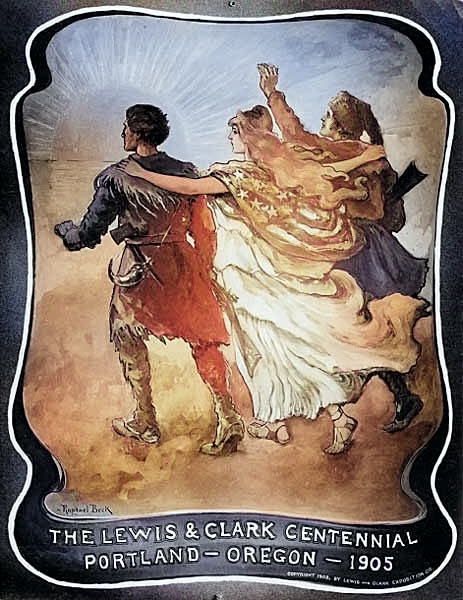
Colorized from the original by Raphael Beck.
Like many after him, libertarian Louis Philippe Gallot de Lormerie appears to have been swept away by the success of the Western Expedition. See also Becoming an American Epic and Assessing the Legacy of Lewis and Clark.
Philadelphia 30 Novembre 1806
The details recently published concerning the admirable expedition of Captains Lewis and Clark to the Pacific Ocean by way of your continent have led me to regard this expedition as the finest undertaking that philosophy, clothed in authority, has yet been able to conceive and execute. It is doubtless one of the most sublime conceptions of the statesman; for what sources of prosperity for your commerce and your navigation! What advantages for your agriculture and your nascent industries!
. . . . .
P.S. Please excuse me if I do not sign this letter because of the political details it contains.[2]Louis-Philippe Gallot de Lormerie to Thomas Jefferson, Founders Online, National Archives, founders.archives.gov/documents/Jefferson/99-01-02-4609.
Louis Philippe Gallot de Lormerie (b. ca. 1746) was a long-time correspondent with Thomas Jefferson. He considered himself a fellow scientist, aesthetic, and political essayist. In his letters, he often promoted the environmental and civilizational development of the early United States. Earlier in 1803, he had written Jefferson:
Only the arts can civilize human behavior, console men for human cruelty, and prevent or heal the evils that are inseparable from life in society. Introducing the arts into the United States is part of your administration.[3]Lormerie to Jefferson, 15 April 1803, Founders Online, National Archives, founders.archives.gov/documents/Jefferson/01-40-02-0154 [Original source: The Papers of Thomas Jefferson, vol. 40, 4 … Continue reading
Tavern at Seven Mile Ford
On the Middle Fork of the Holston River at Seven Mile Ford in Smyth County, the Preston House (also known as Herondon) was built in 1842 for John Montgomery Preston . . . . Preston built the structure as a conspicuously grand tavern, placing it on the site of an earlier log tavern. The first building had a dubious reputation, and tradition has it that Preston wanted to rid the region of its stigma by creating a clearly superior establishment.[4]“Preston House”, The Virginia Department of Historic Resources, www.dhr.virginia.gov/historic-registers/086-0003/, accessed 28 September 2026.
For some years prior to the building of the present house, a log tavern had stood on the site. This hostelry had quite a dubious reputation in the area, as the innkeeper was believed to take advantage of the unwary, even going to the extreme of robbing and murdering the unprotected. This tradition was perhaps substantiated in the 1890s when twenty-one bodies were discovered in a cave on the property.[5]“Preston House (Herondon)”, National Register of Historic Places nomination form (Seven Mile Ford, Virginia), … Continue reading
Preston House at Seven Mile Ford
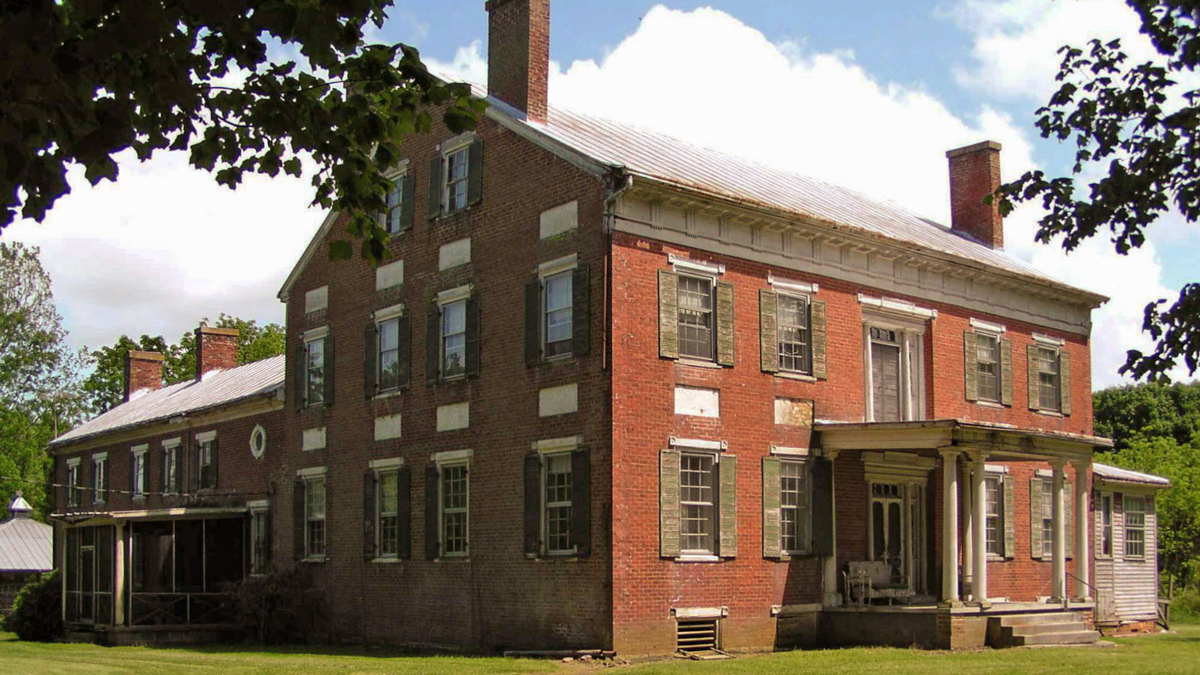
Mike Police, 2004 for the Virginia Department of Historic Resources.
Undoubtedly, Lewis would have preferred this grand hostelry over the notorious cabin that preceded it.
Notes
| ↑1 | Traveling with Meriwether Lewis to Washington City is a Mandan delegation from the Knife River Villages—Chief Sheheke, his wife Yellow Corn, and their son. Speaking Mandan and French was interpreter René Jusseaume who brought one of his wives and two children. Expedition private François Labiche was included to translate between French and English. Finally, records indicate expedition sergeant John Ordway was serving as Lewis’s assistant. During this time, William Clark remained at his home at the Falls of the Ohio. |
|---|---|
| ↑2 | Louis-Philippe Gallot de Lormerie to Thomas Jefferson, Founders Online, National Archives, founders.archives.gov/documents/Jefferson/99-01-02-4609. |
| ↑3 | Lormerie to Jefferson, 15 April 1803, Founders Online, National Archives, founders.archives.gov/documents/Jefferson/01-40-02-0154 [Original source: The Papers of Thomas Jefferson, vol. 40, 4 March–10 July 1803, ed. Barbara B. Oberg (Princeton: Princeton University Press, 2013), 213–216.]. |
| ↑4 | “Preston House”, The Virginia Department of Historic Resources, www.dhr.virginia.gov/historic-registers/086-0003/, accessed 28 September 2026. |
| ↑5 | “Preston House (Herondon)”, National Register of Historic Places nomination form (Seven Mile Ford, Virginia), www.dhr.virginia.gov/wp-content/uploads/2018/04/086-0003_Preston_House_1969_NRHP_nomination_Final.pdf. |
Experience the Lewis and Clark Trail
The Lewis and Clark Trail Experience—our sister site at lewisandclark.travel—connects the world to people and places on the Lewis and Clark Trail.
Discover More
- The Lewis and Clark Expedition: Day by Day by Gary E. Moulton (University of Nebraska Press, 2018). The story in prose, 14 May 1804–23 September 1806.
- The Lewis and Clark Journals: An American Epic of Discovery (abridged) by Gary E. Moulton (University of Nebraska Press, 2003). Selected journal excerpts, 14 May 1804–23 September 1806.
- The Lewis and Clark Journals. by Gary E. Moulton (University of Nebraska Press, 1983–2001). The complete story in 13 volumes.
This site is provided as a public service by the
Lewis and Clark Trail Alliance
with additional funding from the following: