On or near this date, the expedition’s boats must be navigated around the many islands crowding the Ohio River above the mouth of the Cumberland River. Here, Native Americans living along the river look to trade with travelers coming down the river.[1]Neither captain appears to be keeping a journal as the expedition travels between Louisville and Fort Massac and their precise location on this date is unknown.
Above the Cumberland
1814 Map of the Lower Ohio
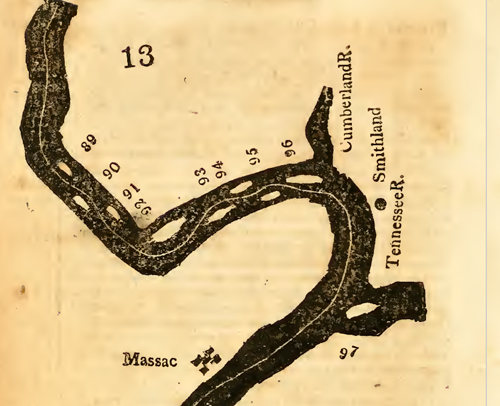
Zadok Cramer, The Navigator, 1814.
The islands above the mouth of Tennessee presented a series of navigational challenges. To find a suitable channel, Rodney scouted ahead in his party’s ‘skiff’:
We went on for the 2d island, but a little before we got to it we easy [eased] on a sand bar in the middle of the river. By steering for the right side of the island I turnd out in the skiff, and soon found we were flose to the channel, and that it was on the Kentucky side the island. We pushed of[f] into the current and went with it to the island where it was deep and then rowed again.
Passed the island at half after 7, and at 8 passed an Indian camp on Kentucky shore. We could only see their fire but as they haild we answered them but could not be understood and passed on. Soon after the water shoaled and we ankord.
—Thomas Rodney, 1 November 1803[2]Dwight L. Smith and Ray Swick, ed., A Journey Through the West: Thomas Rodney’s 1803 Journal from Delaware to the Mississippi Territory (Athens: Ohio University Press, 1997), 158.
In Cramer’s map shown here, islands 89–91 are the present First, Second, and Third Sisters followed by Stewart’s Island (92) and the Cumberland Islands (93–96). This map was not in the editions of Cramer’s The Navigator available in 1803 so the captains—or their pilot—would need to send the pirogues ahead to find the correct channel. This slowed forward progress considerably.
Lewis and Clark on the Ohio
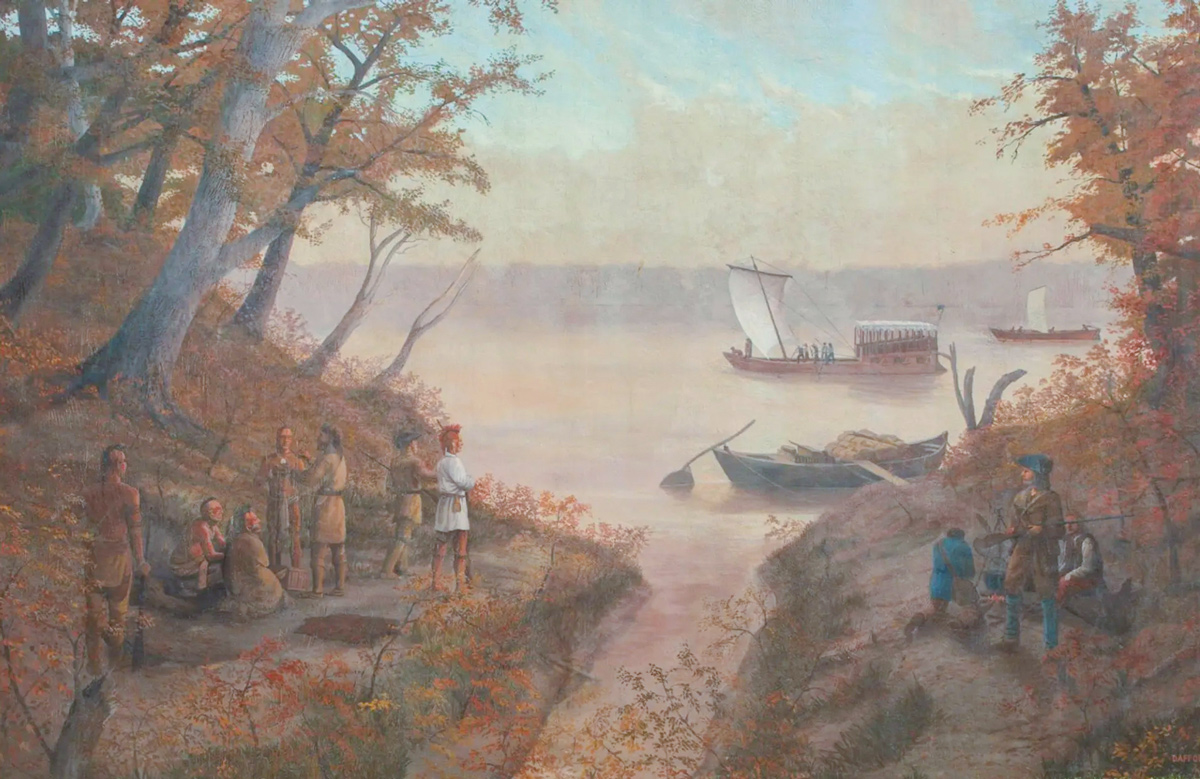
From the Peducah, Kentucky Wall-to-Wall Mural Project.
Three Cherokee Men
. .. . three Cherokee Indians in a canoe come on board from the NW shore. They had venison but we did not want any. We gave them a dram of whisky and some buiscuit and they went off to the settlement on the Kentucky shore. The chief had a peice of flowerd cut tin in his nose and a crisent of tin such as the Masons wore hung round his neck with a buffello ingraved on it. He could talk and understand a little American but very little. I invited him in the cabbin; and seing my scisors hanging up he took them down and asked for them; but I told him I could not spare them, and he put them back again.
—Thomas Rodney, 1 November 1803[3]Rodney, Journal, 156.
A Modest Family
Soon after we cast ankor an old Indian man and his wife and two girls and a boy came on board of us. They were very modest and wanted several things we could not spare; but I gave one of the girls, the youngest of the two and a hansome girl, some flour in the sleave of an old clean shirt, and she returned me a fine ham of venison, and gave each of them a biscuit and the old man a twist of tobacco.
The old man and woman had no ornaments. The eldest girl had a necklace of glass purple beads and a half a dozen ringlets of tin bobs in each ear. They had some durty raged linnen and calico beside their blankets around them. They, I presume, however, were not of much distinction; nor could we larn of what nation they were as they could not talk our language or we theirs; only the old woman on seeing a cheese pronounced the name very distinctly.
—Thomas Rodney, 2 November 1803[4]Rodney, Journal, 160.
Experience the Lewis and Clark Trail
The Lewis and Clark Trail Experience—our sister site at lewisandclark.travel—connects the world to people and places on the Lewis and Clark Trail.
Plan a trip related to November 9, 1803:
Notes
| ↑1 | Neither captain appears to be keeping a journal as the expedition travels between Louisville and Fort Massac and their precise location on this date is unknown. |
|---|---|
| ↑2 | Dwight L. Smith and Ray Swick, ed., A Journey Through the West: Thomas Rodney’s 1803 Journal from Delaware to the Mississippi Territory (Athens: Ohio University Press, 1997), 158. |
| ↑3 | Rodney, Journal, 156. |
| ↑4 | Rodney, Journal, 160. |