On or near this date, the expedition passes the mouth of the Cumberland and then the Tennessee River. Both rivers were fronted by islands making getting to them difficult. This did not deter the Indigenous People who had long used the two rivers as travel ways into present Kentucky and Tennessee.[1]Neither captain appears to be keeping a journal as the expedition travels between Louisville and Fort Massac and their precise location on this date is unknown.
The Cumberland River
With some difficulty and much rowing, we forced our boats into the narrow Kentucky channel of the second Cumberland island a mile below the first, as otherwise we should not have been able to have got into Cumberland river, which the second island overlaps. A mile more brought us to the entrance of Cumberland river, across which we rowed, and moored at the little town of Smithland.
On the whole it is a miserable place, and a traveller will scarcely think himself repaid by a sight of the Cumberland; for stopping at Smithland.
—Fortescue Cuming, winter 1807[2]Fortescue Cuming, Sketches of a Tour to the Western Country: Through the States of Ohio and Kentucky, a voyage down the Ohio and Mississippi rivers, and a trip through the Mississippi territory, and … Continue reading
Mouth of the Cumberland Today
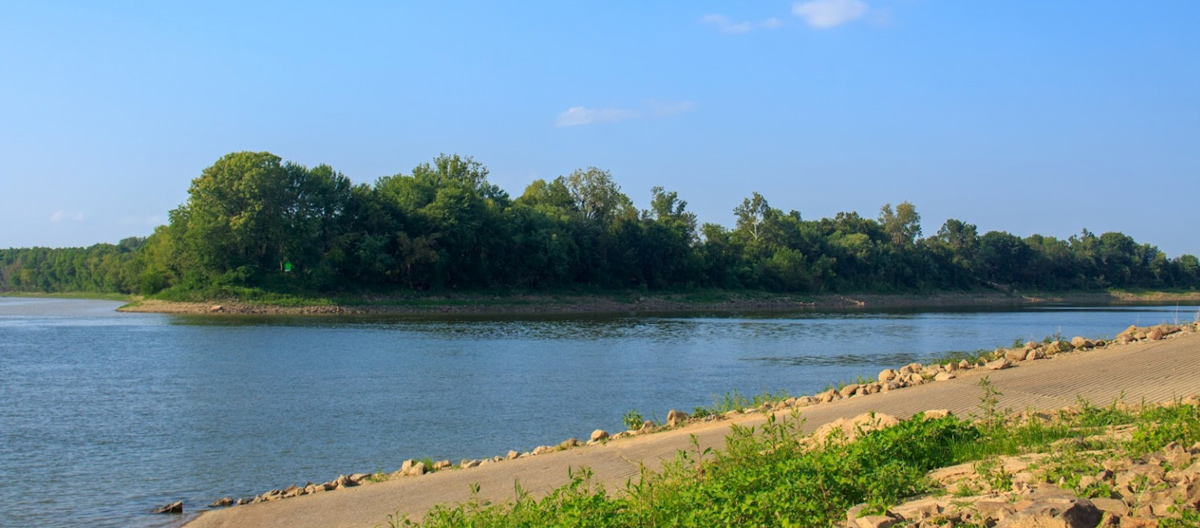
Photo by Andria Vincent, September 2019.
The Tennessee River
[P]assed the mouth of the Tenesse River. It is covered by two small long islands, so that you cannot see the mouth till you git below the lower island where it open with great dignity, being half as wide as the Ohio itself and by far superior to every other branch of it.
—Thomas Rodney, 3 November 1803[3]Dwight L. Smith and Ray Swick, ed., A Journey Through the West: Thomas Rodney’s 1803 Journal from Delaware to the Mississippi Territory (Athens: Ohio University Press, 1997), 162.
The “Cherokee” River
In 1766, Captain Henry Gordon, chief engineer in the Western Department of North America joined with British Army engineer Thomas Hutchins and Indian agent George Croghan to survey the Ohio River territory acquired by the 1763 Treaty of Paris. His journal explains the strategic importance of the Tennessee River.
The reason of the French’s sending a Garrison to this Place [Fort Massac], was to be a Check on the Cherokee Parties that came down the River of that Name [present Tennessee River], which is Navigable for Canoes from their upper Towns, and who harrassed Extremely the French Traders intending to go among the Wabash and Shawnes Nations . . . .
—Captain Harry Gordon, 6 August 1766[4]“Journal of Captain Harry Gordon”, in Travels in the American Colonies, Newton D. Mereness, ed. (New York: The Macmillan Company, 1916), 470, available at … Continue reading
Experience the Lewis and Clark Trail
The Lewis and Clark Trail Experience—our sister site at lewisandclark.travel—connects the world to people and places on the Lewis and Clark Trail.
Plan a trip related to November 10, 1803:

Notes
| ↑1 | Neither captain appears to be keeping a journal as the expedition travels between Louisville and Fort Massac and their precise location on this date is unknown. |
|---|---|
| ↑2 | Fortescue Cuming, Sketches of a Tour to the Western Country: Through the States of Ohio and Kentucky, a voyage down the Ohio and Mississippi rivers, and a trip through the Mississippi territory, and part of West Florida, commenced at Philadelphia in the winter of 1807 . . . (Pittsburgh: Cramer, Spear, & Eichbaum, 1810), 249–50. |
| ↑3 | Dwight L. Smith and Ray Swick, ed., A Journey Through the West: Thomas Rodney’s 1803 Journal from Delaware to the Mississippi Territory (Athens: Ohio University Press, 1997), 162. |
| ↑4 | “Journal of Captain Harry Gordon”, in Travels in the American Colonies, Newton D. Mereness, ed. (New York: The Macmillan Company, 1916), 470, available at www.archive.org/details/merenesscolonies00newtrich. For more, see “Thomas Hutchins”, Wikipeida, en.wikipedia.org/wiki/Thomas_Hutchins. |