While at Fort Massac 38 miles above the mouth of the Ohio, soldiers are recruited and George Drouillard is sent to bring more soldiers from a fort in Tennessee. Lewis begins taking celestial observations but is deterred by clouds.
Missing Tennessee Soldiers
Opposit the Mouth of Missourie
December 16th 1803Dear Brother
The men we expected to meet us at Fort Massac were not thure, which obliged us to Send an express to Tennessee for those men to percue us to our winter quarters,—, we Calld for a Detatchment of 14 men from that garrison to accompany us as far as Kaskaskees at wich place we intended to ogment our permonant party
Brother
Wm Clark[1]James J. Holmberg, ed. Dear Brother: Letters of William Clark to Jonathan Clark (New Haven: Yale University Press, 2002), 60.
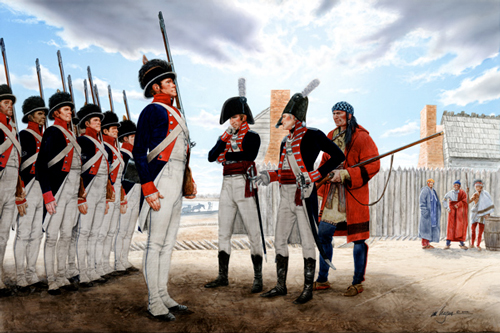
In the figure, the captains inspect candidates from Fort Massac while George Drouillard looks on. Soldiers recruited there include Joseph Whitehouse and John Newman. The express agent sent for more Ohio River recruits was George Drouillard. He traveled to Fort Southwest Point and returned to the expedition’s winter camp—Camp River Dubois—on 22 December with eight soldiers and two horses.
Equal Altitudes
took equal altitudes A. M. but was prevented from compleating the observation by taking an observation in the evening by the clouds—
—Meriwether Lewis
Using a Sextant
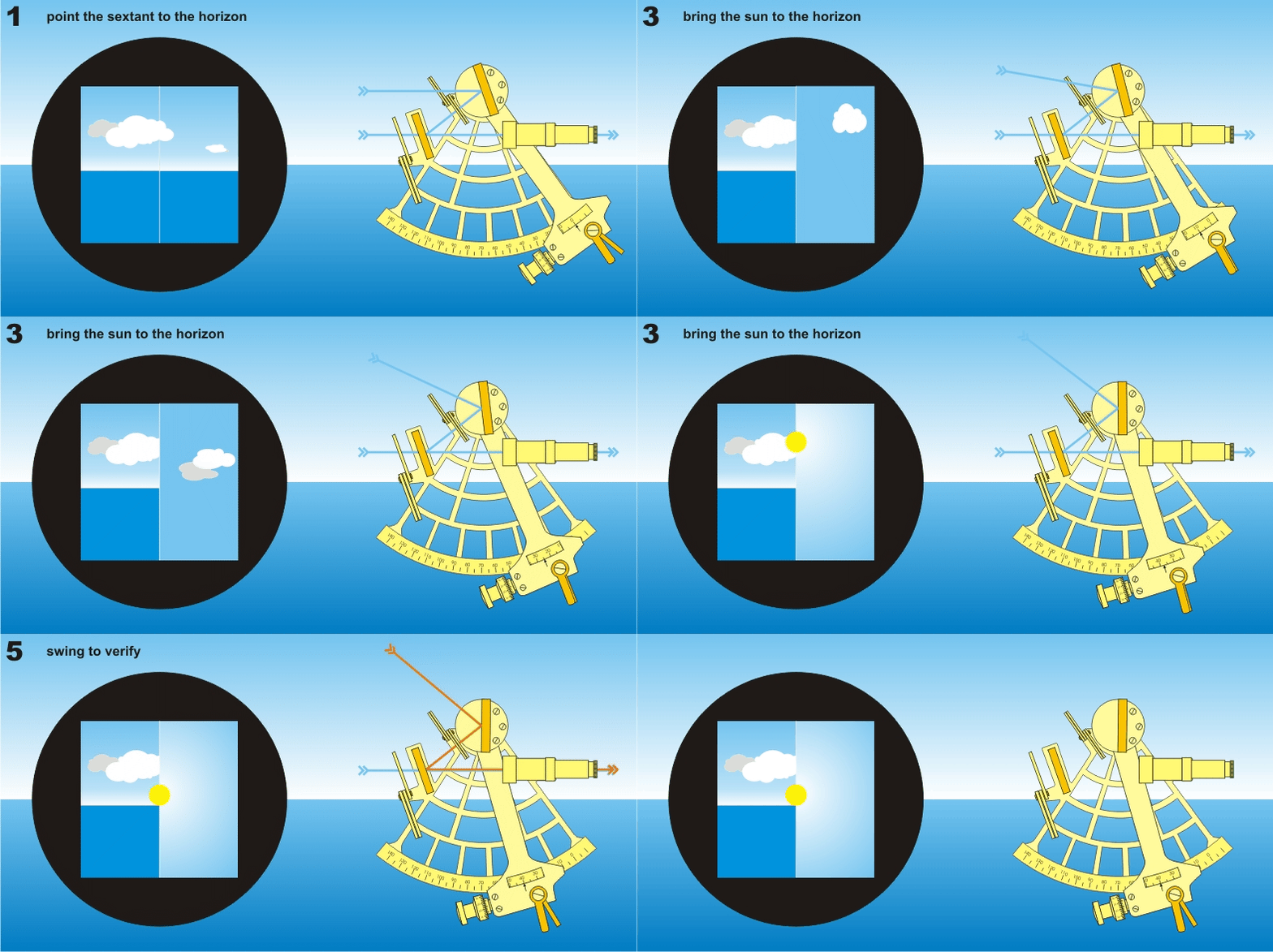
Measuring equal altitudes was the most accurate method to determine when the sun reached the highest point in the sky—Local Apparent Noon. The difference between Local Apparent Noon and Greenwich Mean Time enabled navigators to determine their longitude. An accurate calculation relied on precise measurements with the sextant and a reliable chronometer.
Lewis typically took his Equal Altitudes observations as follows:
- He set out the artificial horizon.
- When the sun was nearly east or rising rapidly and had reached an altitude high enough to reduce the effects of refraction, he measured the altitude of the sun’s upper limb—that is, the upper edge of its disk—with the sextant and, simultaneously, had an assistant note and record the time shown by the chronometer. He then locked the index arm at the angle observed,
- Leaving the index arm locked at the angle observed, he called out to his assistant when the sun’s center reached that altitude. The assistant noted and recorded the time.
- When the sun’s lower limb reached that same altitude Lewis again called out to his assistant to note and record the time.
- Lewis then verified the altitude shown by the sextant’s index, recorded that altitude, then put the sextant away until the afternoon sun descended nearly to the altitude of the morning measurements.
- As the afternoon sun’s lower limb, center, and upper limb successively reached the altitude locked on the sextant’s index arm, Lewis called out to his assistant to note and mark the time.
—Robert N. Bergantino in The Kansas River Observations.
Experience the Lewis and Clark Trail
The Lewis and Clark Trail Experience—our sister site at lewisandclark.travel—connects the world to people and places on the Lewis and Clark Trail.
Plan a trip related to November 12, 1803:
Notes
| ↑1 | James J. Holmberg, ed. Dear Brother: Letters of William Clark to Jonathan Clark (New Haven: Yale University Press, 2002), 60. |
|---|