Lewis breaks the apparent pause in his journal by writing ‘arrived at Fort Massac‘. There, George Drouillard signs on as an interpreter, and he is given an advance in pay.
A Strategic Location
Located about 38 miles before the Ohio’s confluence with the Mississippi, Fort Massac was originally built during the French and Indian War in 1757. After the war, the French left the fort and some Chickasaws destroyed it. In 1766, the site was recommended for a British outpost:
[T]he Situation of this Fort is a good one; Jetting with a Point a little into the River, the Reach of which up and down it discovers to a Considerable distance; a Garrison here will protect the Traders that come down the Ohio, untill they have accounts from the Ilinois; It will prevent those of the French going up the Ohio or among the Wabash Indians.
—Captain Harry Gordon, 6 August 1766[1]“Colonel William Fleming’s Journal of Travels in Kentucky, 1779–1780” in Travels in the American Colonies, Newton D. Mereness, ed. (New York: The Macmillan Company, 1916), 470, … Continue reading
Fort Massac on the Horizon
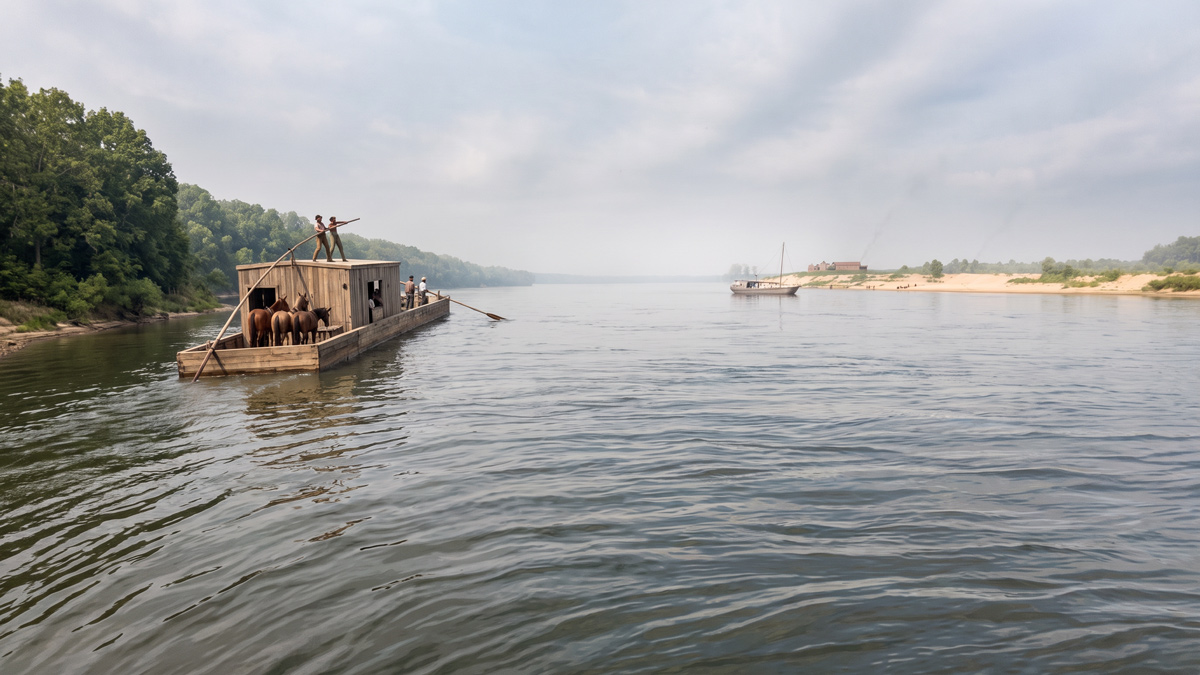
Generated from a display at Fort Massac State Park. Original photo by Kelly Stogner, February 2021, available at Google Maps.
The Wide Ohio
[F]rom whence is a view upwards to Tennessee river, downwards about two miles, and the opposite shore which is one mile and a quarter distant-the Ohio being now so wide.
—Fortescue Cuming, winter 1807)[2]Fortescue Cuming, Sketches of a Tour to the Western Country: Through the States of Ohio and Kentucky, a voyage down the Ohio and Mississippi rivers, and a trip through the Mississippi territory, and … Continue reading
Military Order
During the Revolutionary War, George Rogers Clark led his men through the area, but it would not be until the Northwest Indian War that the United States rebuilt the fort. In 1803, it was the Western headquarters for the Army, and one week prior to the expedition’s arrival, Thomas Rodney was impressed:
It [Fort Massac] appears to be in good order and the soldiers on duty. It is a small fort stockade round, with 6 or 9 inch pointed posts ten to 12 feet high, with a shallow ditch and bank, and is supplied with several pieces of brass cannon beside musquitry and other guns. The soldiers we saw appeared well dressed and neat and clean.
—Thomas Rodney, 4 November 1803[3]Dwight L. Smith and Ray Swick, ed., A Journey Through the West: Thomas Rodney’s 1803 Journal from Delaware to the Mississippi Territory (Athens: Ohio University Press, 1997), 163.
Fort Massac (model)
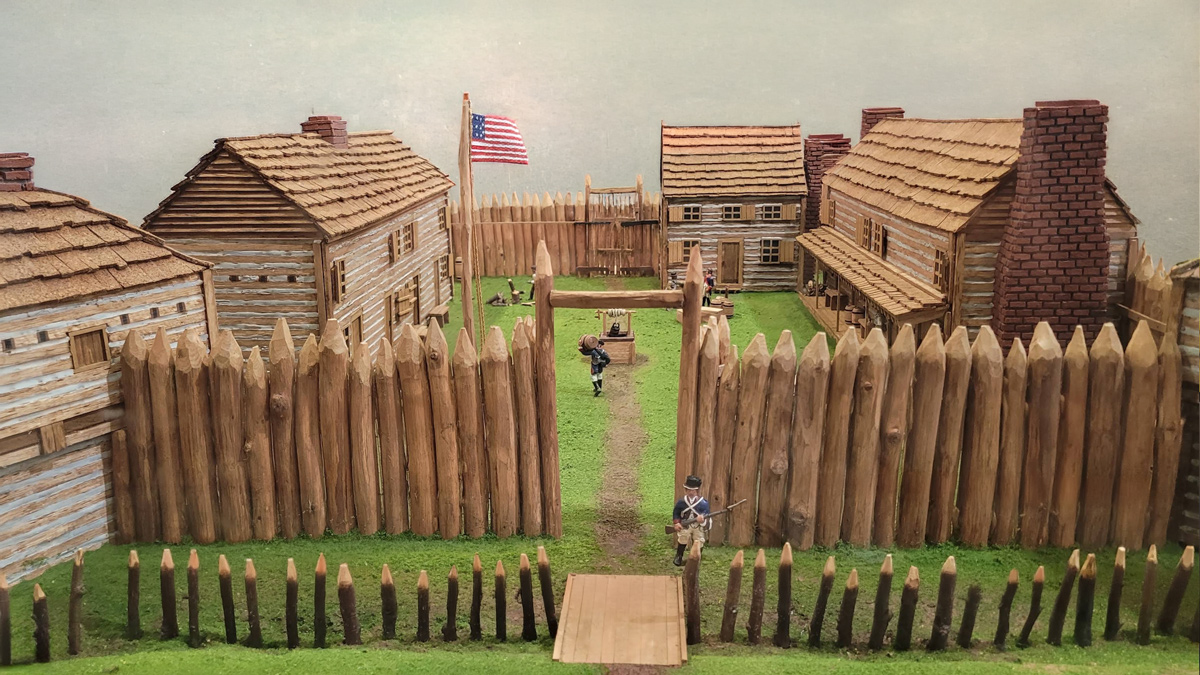
Display at Fort Massac State Park. Modified from the original by Chad Frey, July 2021 posted at Google Maps.
Drouillard Signs On
Arrived as Massac engaged George Drewyer in the public service as an Indian Interpretter, contracted to pay him 25 dollards pr. month for his services.— Mr Swan Assistant Millitary agent at that place advanced him thirty dollars on account of his pay.
—Meriwether Lewis
Drouillard’s contract may have been for the short-term as he did not decide to accompany the expedition to the Pacific until 25 December.
A Man of Much Merit
Born of a French Canadian father and Shawnee mother near Detroit, Drouillard would settle with some of his Shawnee relatives at Cape Girardeau on the Mississippi. Of Drouillard, Lewis would later write:
A man of much merit; he has been peculiarly useful from his knowledge of the common language of gesticulation, and his uncommon skill as a hunter and woodsman. Those several duties he performed in good faith, and with an ardor which deserves the highest commendation.
—Meriwether Lewis, January 15, 1807[4]Meriwether Lewis to Henry Dearborn in Letters of the Lewis and Clark Expedition with Related Documents: 1783–1854, ed. Donald Jackson (Urbana: University of Illinois Press, 1978), 368.
Experience the Lewis and Clark Trail
The Lewis and Clark Trail Experience—our sister site at lewisandclark.travel—connects the world to people and places on the Lewis and Clark Trail.
Plan a trip related to November 11, 1803:
Notes
| ↑1 | “Colonel William Fleming’s Journal of Travels in Kentucky, 1779–1780” in Travels in the American Colonies, Newton D. Mereness, ed. (New York: The Macmillan Company, 1916), 470, available at www.archive.org/details/merenesscolonies00newtrich. |
|---|---|
| ↑2 | Fortescue Cuming, Sketches of a Tour to the Western Country: Through the States of Ohio and Kentucky, a voyage down the Ohio and Mississippi rivers, and a trip through the Mississippi territory, and part of West Florida, commenced at Philadelphia in the winter of 1807 . . . (Pittsburgh: Cramer, Spear, & Eichbaum, 1810), 251. |
| ↑3 | Dwight L. Smith and Ray Swick, ed., A Journey Through the West: Thomas Rodney’s 1803 Journal from Delaware to the Mississippi Territory (Athens: Ohio University Press, 1997), 163. |
| ↑4 | Meriwether Lewis to Henry Dearborn in Letters of the Lewis and Clark Expedition with Related Documents: 1783–1854, ed. Donald Jackson (Urbana: University of Illinois Press, 1978), 368. |