Lewis and the Mandan delegates continue on Virginia’s Wilderness Road bound for Washington City. On or near this date, they cross the Clinch River, pass through Moccasin Gap, and reach what many considered the start of the Wilderness Road—Anderson Block House.[1]Traveling with Meriwether Lewis to Washington City is a Mandan delegation from the Knife River Villages: Chief Sheheke, his wife Yellow Corn, and their son. Speaking Mandan and French was interpreter … Continue reading
Elsewhere, news of a Federal Grand Jury enquiry into the conduct of Aaron Burr reaches the Falls of the Ohio. Coincidentally, Aaron Burr himself arrives in Louisville where he defends himself in a letter to Governor Harrison. Unknown to the Louisville citizens, President Thomas Jefferson issues a proclamation for Burr’s arrest.
In the Rocky Mountains of Colorado, Zebulon Pike sees the “Grand Peak” that would be later named after him.
Crossing the Clinch
crossed Clinch which was rising so deep some of the horses were swimming in the midle of the River a swarm of Flies settled on my horses head and set him a plunging however I got safe over. We halted when we got over the River, then crossed several steep hills stoney road and Miry places a fresh Indian Tract was discovered, which brought our company into a litle Order encamped two miles from Moccasin.
—William Fleming, 19 May 1780[2]“Colonel William Fleming’s Journal of Travels in Kentucky,1779–1780” in Travels in the American Colonies, Newton D. Mereness, ed. (New York: The Macmillan Company, 1916), … Continue reading
Clinch River
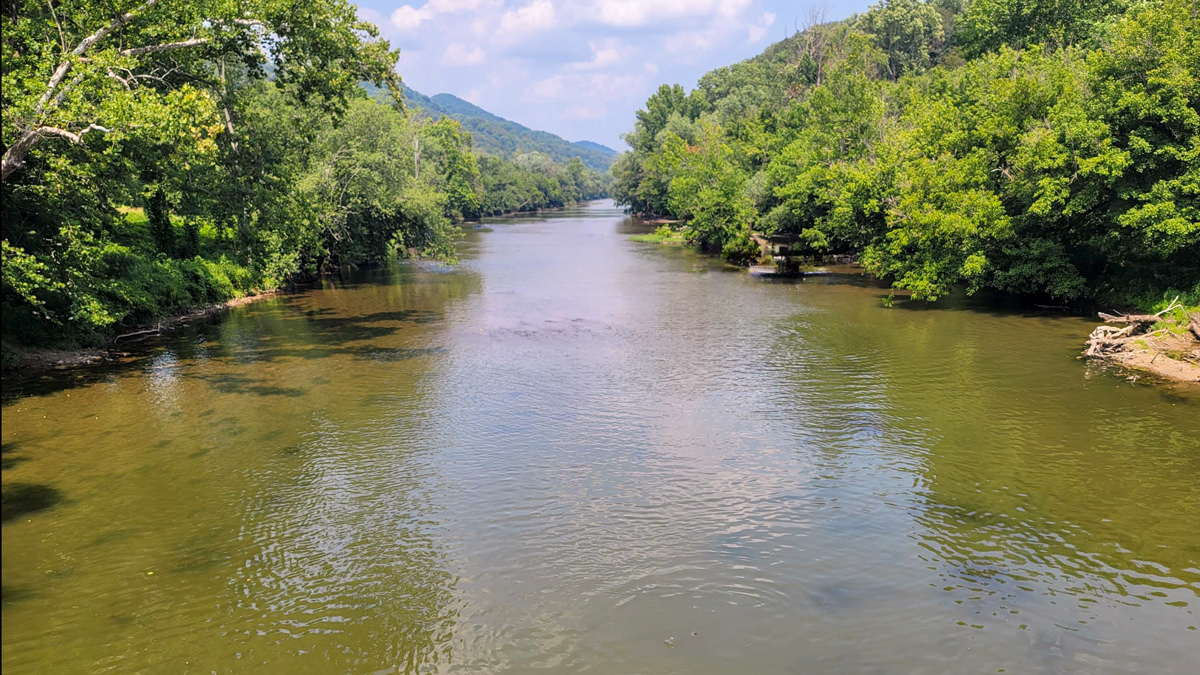
Derived from an original photo provided by Clinch River Life, August 2021, posted at Google Maps.
Aaron Burr’s Investigation
Aaron Burr (1802)
By John Vanderlyn
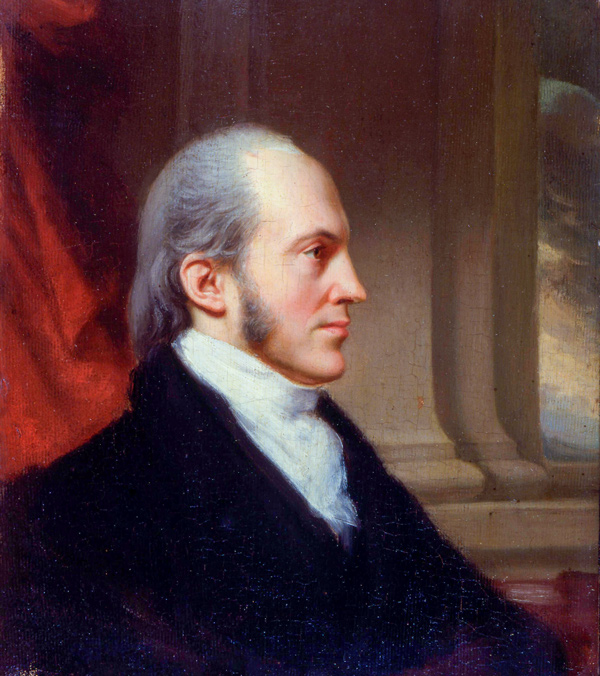
Oil on canvas, 22 1/4 × 16 1/2 in. The New York Historical, gift of Dr. John E. Stillwell.
When John Vanderlyn (1775-1852) arrived in New York City from Kingston, New York in 1792, he honed his painting skills by copying portraits by Gilbert Stuart, among them a painting of Aaron Burr. Impressed by the copy, Burr took Vanderlyn under his wing, sending him to Paris to continue his artistic training at the Ecole des Beaux Arts. Vanderlyn returned to New York in 1801 and, a year later, painted this right-facing portrait of Burr, which became the subject’s standard image.[3]The New York Historical, emuseum.nyhistory.org/objects/41606/aaron-burr-17561836 accessed 2 january 2026.
IN the Federal Court on Tuesday morning last, the attorney for the United States, renewed his motion for a grand jury, to enquire into the conduct of Col. Burr; which the court granted, and directed the marshal to have the jury ready on Tuesday next.
. . . unless a decisive step was now taken, Mr. Burr would be afloat with his flotilla in a short time.
Aaron Burr’s Defense
Louisville, Nov. 27th, 1806.
Dear Sir [His Excellency Gov. Harrison],
Considering the various and extravagant reports which circulate concerning me, it may not be unsatisfactory to you to be informed (and to you there can be no better source of information than myself) that I have no wish or design to attempt a separation of the union, that I have no connection with any foreign power or government, that I never meditated the introduction of any foreign power or influence into the United States, or any parts of its territories . . . .
A. Burr[4]Daniel Clark, Jr. Proofs of the corruption of Gen. James Wilkinson, and of his connexion with Aaron Burr . . ., (Philadelphia: W. Hall, Jun. & Feo. W. Pierie, Printers, 1809) Notes, page 17, … Continue reading
No record indicates whether William Clark met with Aaron Burr while the two were in Louisville. Most likely, Clark wisely distanced himself from Burr to avoid guilt by association.
Thomas Jefferson’s Proclamation
Whereas information has been recieved that sundry persons, citizens of the US. or residents within the same, are conspiring & confederating together to begin & set on foot, provide & prepare the means for a military expedition or enterprize against the dominions of Spain . . . that for this purpose they are fitting out & arming vessels in the Western waters of the US, collecting provisions, arms military stores, and other means are decieving & seducing honest & well meaning citizens . . . .
I have therefore thought fit to issue this my Proclamation, warning & enjoining all faithful citizens who have been led to participate in the sd unlawful enterprizes without due knolege or consideration to withdraw from the same without delay . . . .
and I hereby enjoin and require all officers civil or military of the U.S. or of any of the states or territories, & especially all Governors, & other executive authorities, all judges, justices, & other officers of the peace all military officers of the army or navy of the US & officers of the militia to be vigilant, each within his respective department and according to his functions, in searching out & bringing to condign punishment all persons engaged or concerned in such enterprize . . . .[5]“Proclamation re Military Expeditions against Spain, 27 November 1806,” Founders Online, National Archives, founders.archives.gov/documents/Jefferson/99-01-02-4596.Paragraphs added for … Continue reading
Pikes Peak in Sight
The unbounded prairie was overhung with clouds, which appeared like the ocean in a storm; wave piled upon wave and foaming, whilst the sky was perfectly clear where we were. Commenced our march up the mountain, and in about one hour arrived at the summit of this chain: here we found the snow middle deep . . . .
The summit of the Grand Peak, which was entirely bare of vegetation and covered with snow, now appeared at the distance of 15 or 16 miles from us . . . .
—Zebulon M. Pike[6]Donald Jackson, The Journals of Zebulon Montgomery Pike (Norman, Oklahoma: University of Oklahoma Press, 1966), 1:350–51.
Colorado Plains
View East
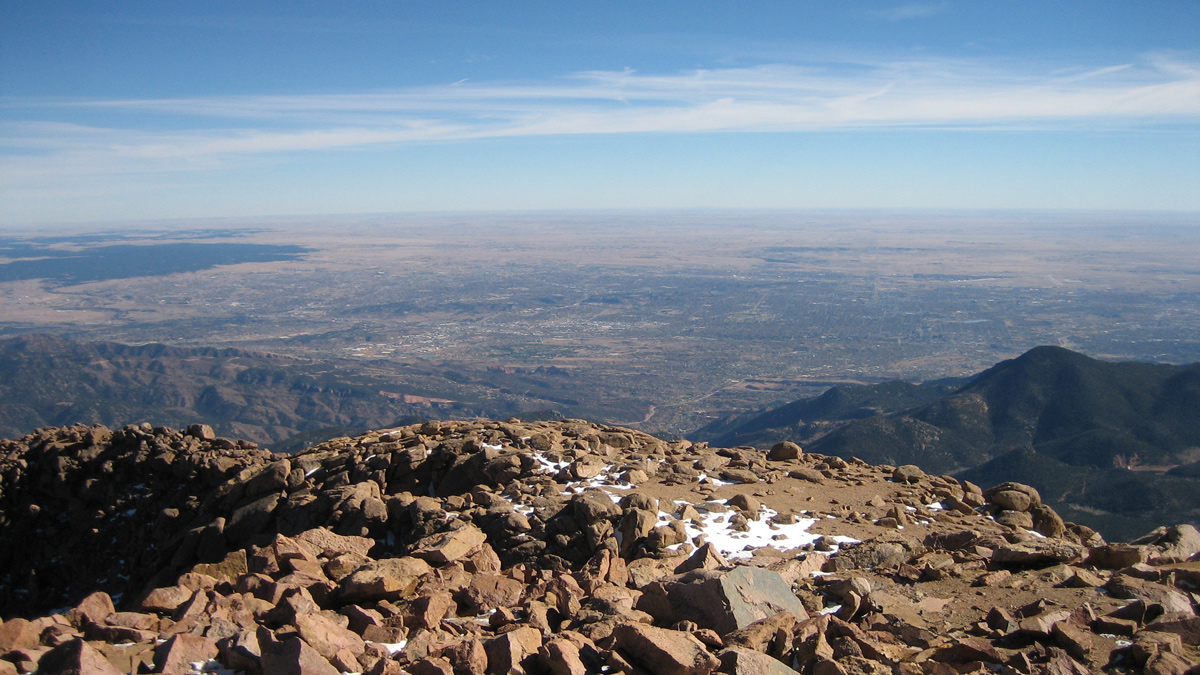
Photo by WikiCommons user DrunkDriver who has released it to the Public Domain, commons.wikimedia.org/wiki/File:Colorado_Springs_from_Pikes_Peak_Nov_2010.JPG.

The above view shows the town of Colorado Springs as viewed from Pikes Peak. Pike did not climb this peak nor did he name it after himself. He climbed a “foothill” to the south—closer to his base camp at Pueblo, Colorado. In addition to Lewis and Clark and Pike’s two expeditions, Jefferson’s Western expeditions included the Hunter and Dunbar Expedition and the Freeman-Custis Expedition.
Notes
| ↑1 | Traveling with Meriwether Lewis to Washington City is a Mandan delegation from the Knife River Villages: Chief Sheheke, his wife Yellow Corn, and their son. Speaking Mandan and French was interpreter René Jusseaume who brought one of his wives and two children. Expedition private François Labiche was included to translate between French and English. Finally, records indicate expedition sergeant John Ordway mhave been serving as Lewis’s assistant. During this time, William Clark remained at his home at the Falls of the Ohio. |
|---|---|
| ↑2 | “Colonel William Fleming’s Journal of Travels in Kentucky,1779–1780” in Travels in the American Colonies, Newton D. Mereness, ed. (New York: The Macmillan Company, 1916), 649–50, available at www.archive.org/details/merenesscolonies00newtrich. |
| ↑3 | The New York Historical, emuseum.nyhistory.org/objects/41606/aaron-burr-17561836 accessed 2 january 2026. |
| ↑4 | Daniel Clark, Jr. Proofs of the corruption of Gen. James Wilkinson, and of his connexion with Aaron Burr . . ., (Philadelphia: W. Hall, Jun. & Feo. W. Pierie, Printers, 1809) Notes, page 17, archive.org/details/proofsofcorrupti00clar. |
| ↑5 | “Proclamation re Military Expeditions against Spain, 27 November 1806,” Founders Online, National Archives, founders.archives.gov/documents/Jefferson/99-01-02-4596.Paragraphs added for clarity. |
| ↑6 | Donald Jackson, The Journals of Zebulon Montgomery Pike (Norman, Oklahoma: University of Oklahoma Press, 1966), 1:350–51. |
Experience the Lewis and Clark Trail
The Lewis and Clark Trail Experience—our sister site at lewisandclark.travel—connects the world to people and places on the Lewis and Clark Trail.
Discover More
- The Lewis and Clark Expedition: Day by Day by Gary E. Moulton (University of Nebraska Press, 2018). The story in prose, 14 May 1804–23 September 1806.
- The Lewis and Clark Journals: An American Epic of Discovery (abridged) by Gary E. Moulton (University of Nebraska Press, 2003). Selected journal excerpts, 14 May 1804–23 September 1806.
- The Lewis and Clark Journals. by Gary E. Moulton (University of Nebraska Press, 1983–2001). The complete story in 13 volumes.
This site is provided as a public service by the
Lewis and Clark Trail Alliance
with additional funding from the following: