On or near this date, the expedition passes a noted tavern at Scuffletown, and they reach the Green River—the “finest of all the rivers” Thomas Rodney has seen so far. Jean-Baptiste Lepage—a French-Canadian trapper with experience on the Missouri River—officially enlists as a private.[1]Neither captain appears to be keeping a journal as the expedition travels between Louisville and Fort Massac and their precise location on this date is unknown.
Scuffletown Landing
Located about eight river miles upstream from the present mouth of the Green River, Jonathan Scott—also known as Scott Fox—established a tavern circa 1800 and other commercial development followed. One legend has the local Cherokee People playing stickball and having wrestling matches—scuffles—here. Apparently, the Ohio River boatmen kept that tradition alive. The tavern was in operation when the Lewis and Clark Expedition passed by in the fall of 1803. The town was damaged and then destroyed by the 1913 and 1937 floods.[2]Leigh Ann Boucher, Henderson County, Kentucky Communities, hendersonkyhistory.com/LostCities1.htm, accessed on 24 December 2018; “Scuffletown, Kentucky”, Kentucky Atlas & Gazetteer, … Continue reading
Scuffletown Landing (stylized)
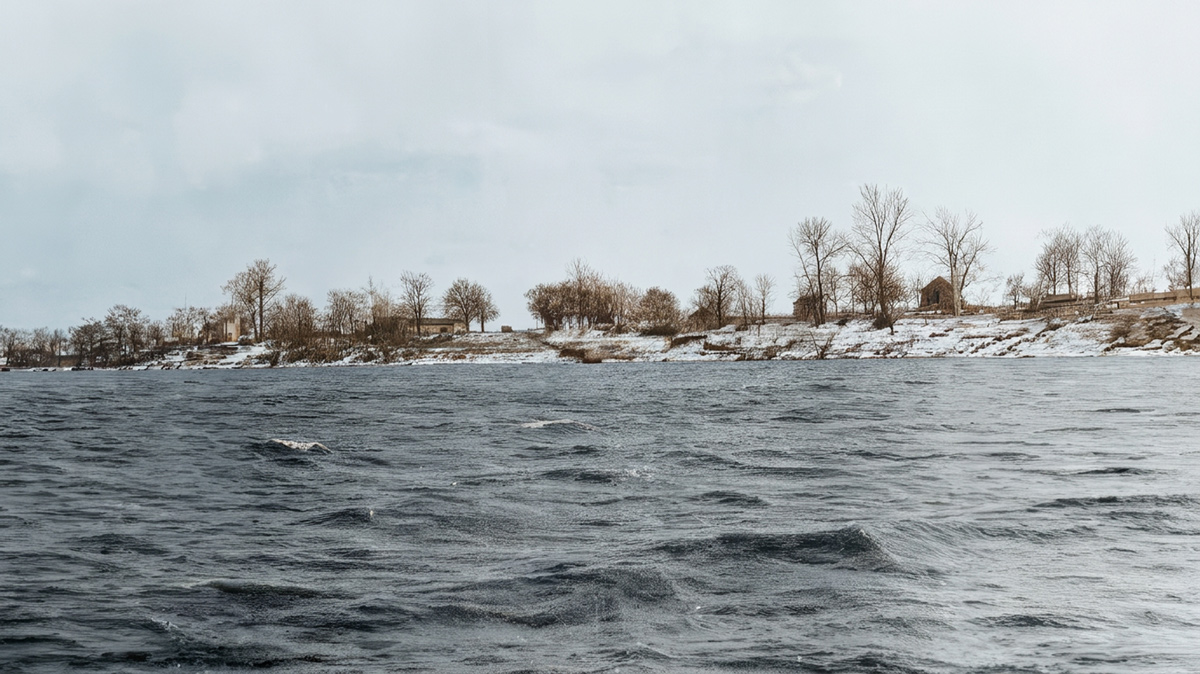
Generated from the original 1930 photo: Ohio River Portrait Project, Kentucky Historical Society, www.kyhistory.com/cdm/singleitem/collection/p16602coll1/id/917/rec/193.
The Green River
Green River is in appearance at the mouth the finest of all the rivers we have seen that fall into the Ohio on the same side; and the Ohio is the finest at the mouth of that river. It is deep quite across and no shoals occur, except a small sand bar just within the mouth of Green River on the lower side, which is no impediment to its navigation.
—Thomas Rodney, 26 October 1803[3]Dwight L. Smith and Ray Swick, ed., A Journey Through the West: Thomas Rodney’s 1803 Journal from Delaware to the Mississippi Territory (Athens: Ohio University Press, 1997), 137.
Pvt. Lepage Enlists
In a summary of extra pay awarded the enlisted men, Clark recorded Jean-Baptiste Lepage’s enlistment as starting on 2 November 1803:
We the Subscribers do acknowledge to have received of [blank] the several Sums set opposite to our names, the Same being due us from the War department pursuant to an Act of Congress bearing date March 3rd 1807, entitled ‘an Act makeing compensation to Messrs. Lewis & Clark and their companions.
. . . .
Name Period of Service Monthly Rate Amount Jean Baptiste Lepage 2 Nov. 1803 to 10 Oct. 1806 5 [$]111.50[4]Donald Jackson citing Yale University Library, New Haven, Connecticut in Letters of the Lewis and Clark Expedition with Related Documents: 1783-1854, 2nd ed. (Urbana: University of Illinois Press, … Continue reading [—William Clark]
Lepage’s Contributions
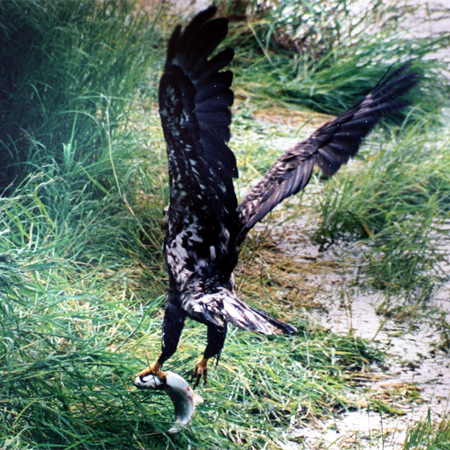
Juvenile Bald Eagle with Salmon
Haliaeetus leucocephalus
© 1998 Mila Zinkova. Permission via the GNU Free Documentation License.
Lepage’s contributions included translating French and English and hunting. At the expedition’s Long Camp on the Clearwater River, he took a salmon from an eagle:
LaPage took a Salmon from an Eagle at a Short distance below our Camp. this is induces us to believe that the Salmon is in this river and most probably will be here in great numbers in the Course of a fiew days.
—William Clark, 18 May 1806
Experience the Lewis and Clark Trail
The Lewis and Clark Trail Experience—our sister site at lewisandclark.travel—connects the world to people and places on the Lewis and Clark Trail.
Plan a trip related to November 2, 1803:
Notes
| ↑1 | Neither captain appears to be keeping a journal as the expedition travels between Louisville and Fort Massac and their precise location on this date is unknown. |
|---|---|
| ↑2 | Leigh Ann Boucher, Henderson County, Kentucky Communities, hendersonkyhistory.com/LostCities1.htm, accessed on 24 December 2018; “Scuffletown, Kentucky”, Kentucky Atlas & Gazetteer, www.kyatlas.com/ky-scuffletown.html, accessed 29 September 2026; “Scuffletown, Henderson County, Kentucky Facts for Kids, Kiddle, kids.kiddle.co/Scuffletown,_Henderson_County,_Kentucky, accessed 29 September 2026. |
| ↑3 | Dwight L. Smith and Ray Swick, ed., A Journey Through the West: Thomas Rodney’s 1803 Journal from Delaware to the Mississippi Territory (Athens: Ohio University Press, 1997), 137. |
| ↑4 | Donald Jackson citing Yale University Library, New Haven, Connecticut in Letters of the Lewis and Clark Expedition with Related Documents: 1783-1854, 2nd ed. (Urbana: University of Illinois Press, 1978), 2:378. |