Named for William Clark
Clarkia, Clarkia pulchella
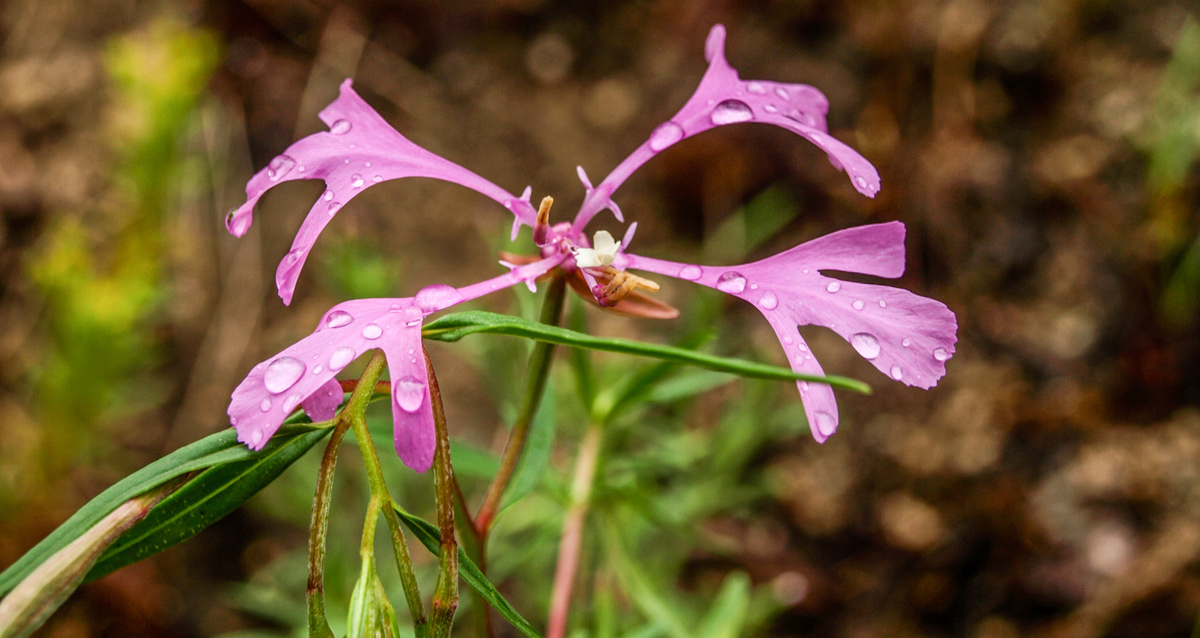
© 2009 Kristopher K. Townsend. Permission to use granted under the Creative Commons Attribution-Share Alike 4.0 International license.
This Clarkia plant was on display on a rainy, early-June day near the Expedition’s route over the Bitterroot Mountains along the Northern Nez Perce Trail, also known as the Lolo Trail. Meriwether Lewis‘s specimen collected at Long Camp would inspire Frederick Pursh to name the entire genus after William Clark.
On their return journey in 1806, the Corps of Discovery had to camp for nearly a month (14 May 1806 to 10 June 1806) in the vicinity of present-day Kamiah (pronounced KAM-ee-eye), Idaho, to wait for the snow to melt in the Bitterroots. Lewis used this time to study and describe many of the plant specimens he had collected. His description of Clarkia is among his most detailed, running to nearly 500 words.
In some localities the plant’s most common name is ragged robin, but it is also known as pink fairy, elk horn, and deer horn. In the spring of 1807, Lewis turned over his plant specimens to the young German American botanist, Frederick Pursh, who gave this flower the scientific name Clarkia pulchella. In so doing, he named an entire genus in honor of Clark. (Pulchella means beautiful.) Appropriately, the best of its common names today is clarkia.
Classifications and Uses
Clarkia is a member of the Evening Primrose—Onagraceae Juss.—family, and seven different species of this lovely flower are found between British Columbia and southern Oregon, and eastward to South Dakota. Only two of them grow in the Rocky Mountains. To date, there are no recorded uses of Clarkia pulchella by Native Americans. We do know that the parched and pulverized seeds of C. amoena and C. bilboa were eaten by the Miwok of Northern California.[1]Samuel A. Barrett and Edward W. Gifford, “Miwok Material Culture: Indian Life of the Yosemite Region,” Bulletin of the Milwaukee Public Museum 2, 137, 153–4.
Of the 40 species in the Clarkia genus, some grow well in gardens: Elegant clarkia (C. unguiculata), redspot clarkia (C. speciosa), farewell to spring (C. amoena), and Botta’s clarkia (C. bottae). Unfortunately, none of the garden species have the deeply lobed horn-shaped petals as does Clarkia pulchella.[2]“Clarkia Pursh” USDA Natural Resources Conservation Service Plants Database, plants.usda.gov/plant-profile/CLARK, accessed 16 June 2025; Susan H. Munger, Common to This Country: Botanical … Continue reading
Lewis’s Specimen
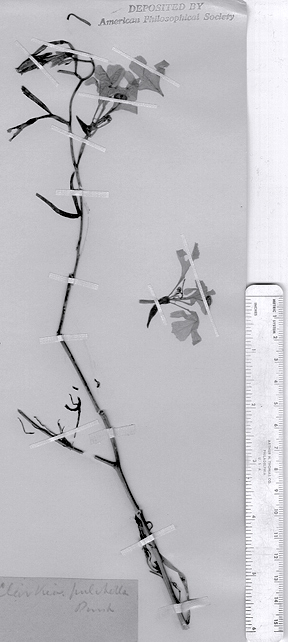
Courtesy Academy of Natural Sciences, Philadelphia.
The specimen shown above is the dried “singular plant” that Lewis collected, and which, in 1814, botanist Frederick Pursh named Clarkia pulchella. The label at lower left, applied to the original specimen sheet in 1896 by botanist Thomas Meehan of the Academy of Natural Sciences, reads “Clarkia pulchella Pursh.” An additional label, not shown here, which possibly was written by Pursh, says “A beautifull herbaceous plant from the Kooskooskee & Clark’s R. Jun. 1st 1806.”
Pursh’s Painting
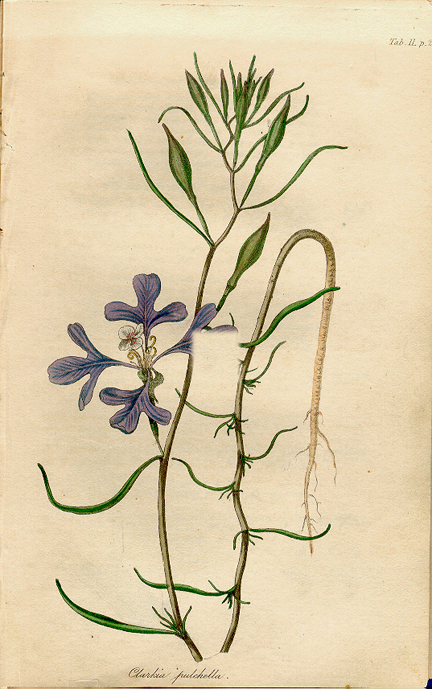
Pursh, Flora Americae Septentrionalis.
It is believed that Pursh based this painting on sketches he made for Lewis when the latter was in Philadelphia in 1807. He most likely used the specimen(s) brought back by Lewis to classify and draw the plant.[3]James L. Reveal, Gary E. Moulton, and Alfred E. Schuyler, “The Lewis and Clark Collections of Vascular Plants: Names, Types, and Comments,” Proceedings of the Academy of Natural Sciences … Continue reading In addition to a Latin botanical description, Pursh wrote: “On the Kooskoosky and Clarck’s rivers . . . . Flowers beautiful rose-coloured or purple.”[4]Frederick T. Pursh, Flora Americae Septentrionalis, or, A systematic arrangement and description of the plants of North America . . . . (London: White, Cochrane, and Co., 1813), 260.
Lewis’s Specimen
Lewis’s Specimen (Detail)
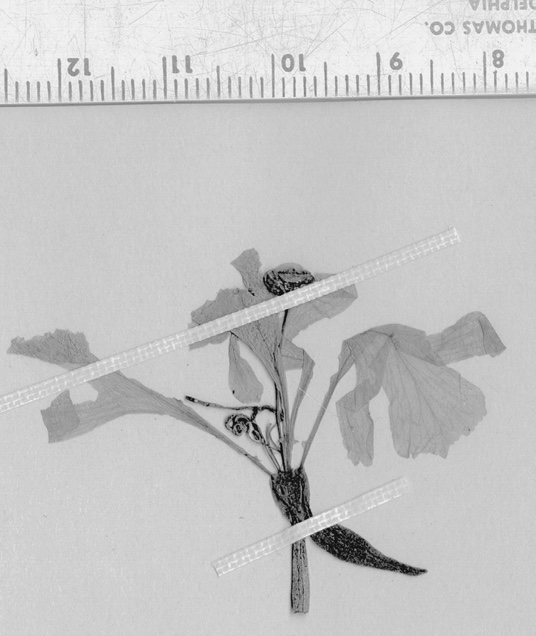
Courtesy Academy of Natural Sciences, Philadelphia.
Clarkia is mentioned only two times in the journals, Lewis’s 1 June 1806 description and Clark’s 29 May description where he most likely backfilled his journal by copying from Lewis. Lewis’s description begins:
I met with a singular plant today in blume of which I preserved a specemine. It grows on the steep sides of the fertile hills near this place.
Lewis then describes the root, stem, branches and leaves:
the radix is fibrous, not much branched, annual, woody, white and nearly smooth. the stem is simple branching ascending, 2½ feet high celindric, villose and of a pale red colour. the branches are but few and those near it’s upper extremity. the extremities of the branches are flexable and are bent down near their extremities with the weight of the flowers. the leaf is sissile, scattered thinly, nearly linear tho’ somewhat widest in the middle, two inches in length absolutely entire, villose, obtusely pointed and of an ordinary green. above each leaf a small short branch protrudes, supporting a tissue of four or five smaller leaves of the same apeparance with those discribed. a leaf is placed underneath eah branch, and each flower.
Lewis continues with the parts of the delicate flower:
the calyx is a one flowered spathe. the corolla superior consists of four pale perple petals which are tripartite, the central lobe largest and all terminate obtusely; they are inserted with a long and narrow claw on the top of the germ, are long, smooth, & deciduous. there are two distinct sets of stamens the 1st or principal consist of four, the filaments of which are capillary, erect, inserted on the top of the germ alternately with the petals, equal short, membranous; the anthers are also four each being elivated with it’s fillament, they are linear and reather flat, erect sessile, cohering at the base, membranous, longitudinally furrowed, twise as long as the fillament naked, and of a pale perple colour. the second set of stamens are very minute are also four and placed within and opposite to the petals, these are scarcely persceptable while the 1st are large and conspicuous; the filaments are capillary equal, very short, white and smooth. the anthers are four, oblong, beaked, erect, cohering at the base, membranous, shorter than the fillaments, white naked and appear not to form pollen. there is one pistillum; the germ of which is also one, cilindric, villous, inferior, sessile, as long as the 1st stamens, and marked with 8 longitudinal furrows. the single style and stigma form a perfect monapetallous corolla only with this difference, that the style which elivates the stigma or limb is not a tube but solid tho’ it’s outer appearance is that of the tube of a monopetallous corolla swelling as it ascends and gliding in such manner into the limb that it cannot be said where the style ends, or the stigma begins; jointly they are as long as the corolla, white, the limb is four cleft, sauser shaped, and the margins of the lobes entire and rounded. this has the appearance of a monopetallous flower growing from the center of a four petalled corollar, which is rendered more conspicuous in consequence of the 1st being white and the latter of a pale perple.[5]Lewis almost certainly included in his “Traveling Library” Benjamin Smith Barton’s Elements of Botany. Whenever possible, definitions in these tooltip annotations are quoted … Continue reading
Lewis ends his description regretting that he would not likely be able to collect any seeds:
I regret very much that the seed of this plant are not yet ripe and it is proble will not be so during my residence in this neighbourhood.—
There is no evidence that he managed to bring back any Clarkia seeds, but later collectors did, and the plant appears to have been growing in Eastern gardens by the 1820s.[6]Munger, 80.
Further Reading
Raymond Burroughs, The Natural History of the Lewis and Clark Expedition. East Lansing: Michigan State University Press, 1995.
Paul Russell Cutright, Lewis and Clark: Pioneering Naturalists. Lincoln: University of Nebraska Press, 1969.
Richard M. McCourt, Catharine Hawks and Earle E. Spamer, “The Lewis and Clark Herbarium of the Academy of Natural Sciences; Part 2, Saving an American Treasure: Preservation of the Herbarium on the Bicentennial of the Expedition,” Notulae Naturae, No. 476 (December 2002).
Gary E. Moulton, ed., The Journals of the Lewis & Clark Expedition (13 vols, Lincoln: University of Nebraska Press, 1983–2001), Vol. 12, Herbarium of the Lewis & Clark Expedition.
James L. Reveal, Gary E. Moulton, and Alfred E. Schuyler, “The Lewis and Clark Collections of Vascular Plants: Names, Types, and Comments,” Proceedings of the Academy of Natural Sciences of Philadelphia, Vol. 149 (29 January 1999), 1–64.
A. Scott Earle and James L. Reveal, Lewis and Clark’s Green World: The Expedition and its Plants (Helena, Montana: Farcountry Press, 2003), 167.
Notes
| ↑1 | Samuel A. Barrett and Edward W. Gifford, “Miwok Material Culture: Indian Life of the Yosemite Region,” Bulletin of the Milwaukee Public Museum 2, 137, 153–4. |
|---|---|
| ↑2 | “Clarkia Pursh” USDA Natural Resources Conservation Service Plants Database, plants.usda.gov/plant-profile/CLARK, accessed 16 June 2025; Susan H. Munger, Common to This Country: Botanical Discoveries of Lewis & Clark (New York: Artisan, 2003), 81; “Clarkia”, Wikipedia, en.wikipedia.org/wiki/Clarkia, accessed 14 June 2025. |
| ↑3 | James L. Reveal, Gary E. Moulton, and Alfred E. Schuyler, “The Lewis and Clark Collections of Vascular Plants: Names, Types, and Comments,” Proceedings of the Academy of Natural Sciences of Philadelphia, Vol. 149 (29 January 1999), 15. |
| ↑4 | Frederick T. Pursh, Flora Americae Septentrionalis, or, A systematic arrangement and description of the plants of North America . . . . (London: White, Cochrane, and Co., 1813), 260. |
| ↑5 | Lewis almost certainly included in his “Traveling Library” Benjamin Smith Barton’s Elements of Botany. Whenever possible, definitions in these tooltip annotations are quoted verbatim from that work. When needed for clarity, The Kew Plant Glossary and Plant Identification Terminology are referenced. Benjamin Smith Barton, Elements of Botany: or Outlines of the Natural History of Vegetables (Philadelphia: 1803), www.google.com/books/edition/Elements_of_Botany_Or_Outlines_of_the_Na/Hk0aAAAAYAAJ?hl=en&gbpv=0; Henk Beentje, The Kew Plant Glossary: An Illustrated Dictionary of Plant Terms (Royal Botanic Gardens: Kew Publishing, 2012); James G. Harris and Melinda Woolf Harris, Plant Identification Terminology: An Illustrated Glossary (Spring Lake, Utah: Spring Lake Publishing, 2009). |
| ↑6 | Munger, 80. |
Experience the Lewis and Clark Trail
The Lewis and Clark Trail Experience—our sister site at lewisandclark.travel—connects the world to people and places on the Lewis and Clark Trail.
Discover More
- The Lewis and Clark Expedition: Day by Day by Gary E. Moulton (University of Nebraska Press, 2018). The story in prose, 14 May 1804–23 September 1806.
- The Lewis and Clark Journals: An American Epic of Discovery (abridged) by Gary E. Moulton (University of Nebraska Press, 2003). Selected journal excerpts, 14 May 1804–23 September 1806.
- The Lewis and Clark Journals. by Gary E. Moulton (University of Nebraska Press, 1983–2001). The complete story in 13 volumes.
This site is provided as a public service by the

Lewis and Clark Trail Alliance
with additional funding from the following: