On or near this day Lewis and the Mandan delegation travel east along Virginia’s Wilderness Road between Martin’s Lower Station and Martin’s Old Station at Glade Spring—present Jonesville.[1]Traveling with Meriwether Lewis to Washington City is a Mandan delegation from the Knife River Villages: Chief Sheheke, his wife Yellow Corn, and their son. Speaking Mandan and French was interpreter … Continue reading
In present Colorado, expedition leader Zebulon Pike and three others leave to summit the Rocky Mountains near the prominent mountain that would be named after him—Pikes Peak.
Martin’s Stations
In 1775, one of this area’s first white travelers described travel here:
Wednesday ye 5th Breaks away fair & we go on down the valey & camp on indian Creek we had this creek to cross maney times & very Bad Banks ABrams saddle turned & the load all fell in we got out this Eavening and Kill two Deer
—William Calk, 3 April 1775[2]Calk’s Journal in William A. Pusey, The Wilderness Road to Kentucky: Its Location and Features (New York: George H. Doran Co., 1921), 43, available at … Continue reading
Martins Station (‘Fourth’ Construction)
Wilderness Road State Park
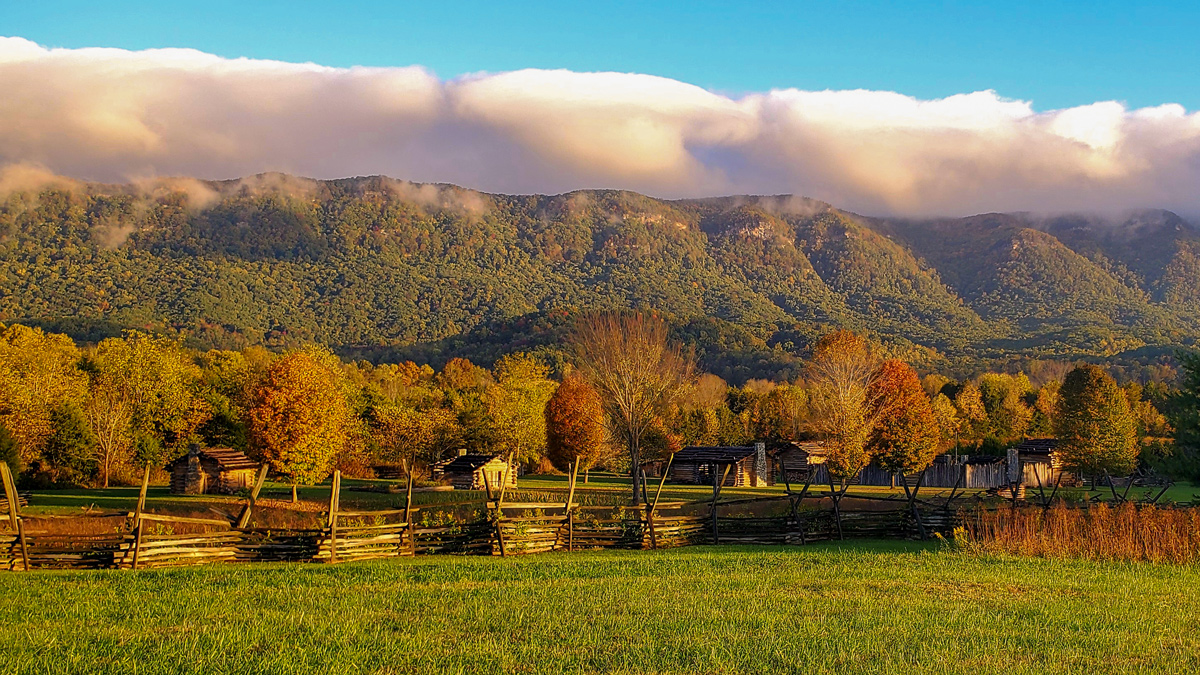
Photo by Virginia State Park Staff, 13 October 2020. Permission to use granted under the Creative Commons Attribution-ShareAlike 2.0 Generic (CC-BY-SA 2.0) license.
Soon after writing this entry, Calk would accompany Richard Henderson between Martin’s Station and Boonesborough, Kentucky. (Henderson was the one who hired Daniel Boone to blaze the Wilderness Road.) By 1806, road forded Indian Creek just three times, and the approaches were well established. There were also stations along the way to feed, shelter and entertain the traveler.
Here, the infamous White Rocks of the Cumberland Mountains intimidated many a traveler. Looming up to 1500 feet above the valley floor as shown above, they seemed to bar all entry into Kentucky. Imagine how Sheheke, Yellow Corn, and the other Mandans felt seeing these nearly vertical cliffs. North Dakota’s highest hills—the Little Missouri Badlands and Killdeer Mountains with elevation changes between 500 and 1,000 feet—spread their rises across tiered badlands and sloping coulees. The Cumberlands may have been the tallest cliffs they had yet seen.
Joseph Martin (1740–1808) built three stations along the Wilderness Road. The first was in 1769 at present Rose Hill, Virginia. He was soon run off by Native Americans. He returned in 1775, rebuilt the station, and was again attacked. In 1783, he built a new station several miles to the west near present Wilderness Road Campground—just three miles from the Cumberland Gap Summit. A ‘fourth’ station was built at Wilderness Road State Park to provide historical interpretation for today’s travelers. Martin’s stations were well-used during the Kentucky migration years—a last chance for supplies and protection.[3]Robert L. Kincaid, The Wilderness Road (Indianapolis: The Bobbs-Merrill Company, 1947), 74, 101, available at archive.org/details/wildernessroad00kinc; “Richard Henderson (jurist)”, … Continue reading
Pikes Peak Excursion Day One
Early in the morning cut down 14 logs, and put up a breast work, five feet high on three sides and the other was thrown on the river. After giving the necessary orders for their government, during my absence, in case of our not returning. We marched about one o’clock with an idea of arriving at the foot of the mountain, but found ourselves obliged to take up our nights lodging under a single cedar, which we found in the prairie, without water and extremely cold.
—Zebulon M. Pike[4]Donald Jackson, The Journals of Zebulon Montgomery Pike (Norman, Oklahoma: University of Oklahoma Press, 1966), 1:349–50.
Rocky Mountain Juniper (Juniperus scopulorum)
Red Canyon Park, Colorado
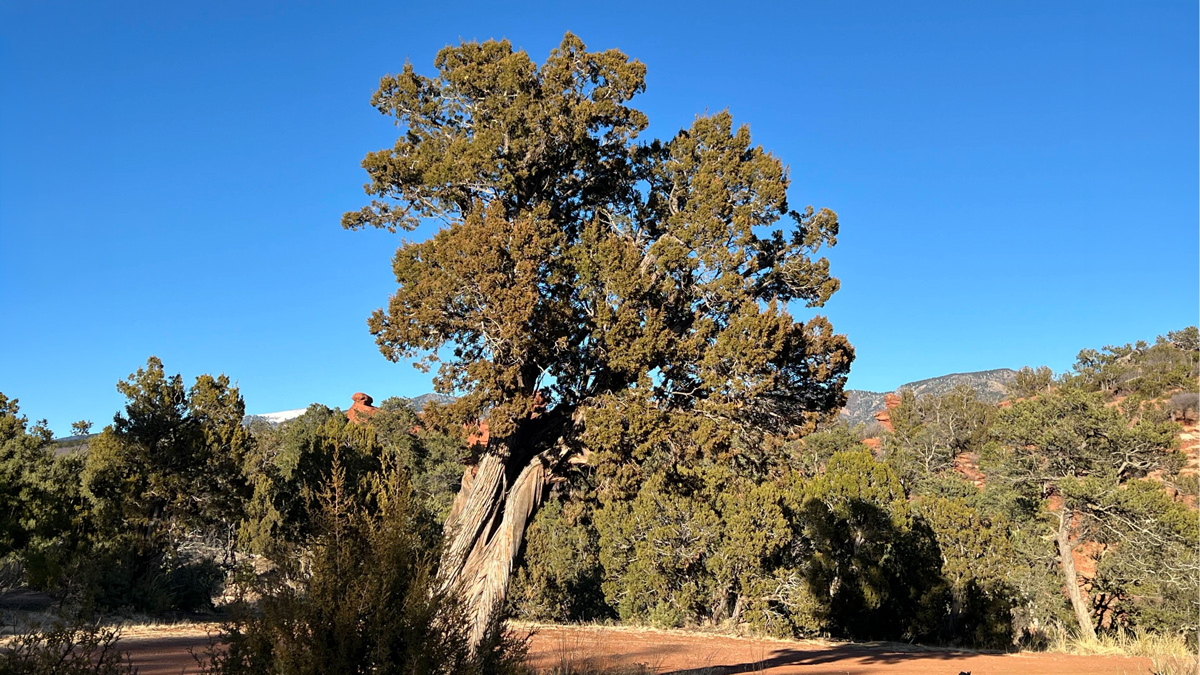
Generated from an original photo by Jean Hazelwood, February 2024. Original posted at Google Maps.
Thus begins a side trip to climb the Rocky Mountain Front. On this day, Pike left his base camp—and most of his men—near present Pueblo, Colorado. On 8 August 1805, Lewis, Drouillard, and Pvt. McNeal headed west on an Indian Road leading to the Continental Divide in present Montana and Idaho. Like Pike, they were wearing summer clothing. See Across the Great Divide.
Notes
| ↑1 | Traveling with Meriwether Lewis to Washington City is a Mandan delegation from the Knife River Villages: Chief Sheheke, his wife Yellow Corn, and their son. Speaking Mandan and French was interpreter René Jusseaume who brought one of his wives and two children. Expedition private François Labiche was included to translate between French and English. Finally, records indicate expedition sergeant John Ordway may have been serving as Lewis’s assistant. |
|---|---|
| ↑2 | Calk’s Journal in William A. Pusey, The Wilderness Road to Kentucky: Its Location and Features (New York: George H. Doran Co., 1921), 43, available at www.archive.org/details/wildernessroadtopuse. |
| ↑3 | Robert L. Kincaid, The Wilderness Road (Indianapolis: The Bobbs-Merrill Company, 1947), 74, 101, available at archive.org/details/wildernessroad00kinc; “Richard Henderson (jurist)”, Wikipedia, https://en.wikipedia.org/wiki/Richard_Henderson_(jurist); “General Joseph Martin”, Wikipedia, en.wikipedia.org/wiki/Joseph_Martin_(general). |
| ↑4 | Donald Jackson, The Journals of Zebulon Montgomery Pike (Norman, Oklahoma: University of Oklahoma Press, 1966), 1:349–50. |
Experience the Lewis and Clark Trail
The Lewis and Clark Trail Experience—our sister site at lewisandclark.travel—connects the world to people and places on the Lewis and Clark Trail.
Discover More
- The Lewis and Clark Expedition: Day by Day by Gary E. Moulton (University of Nebraska Press, 2018). The story in prose, 14 May 1804–23 September 1806.
- The Lewis and Clark Journals: An American Epic of Discovery (abridged) by Gary E. Moulton (University of Nebraska Press, 2003). Selected journal excerpts, 14 May 1804–23 September 1806.
- The Lewis and Clark Journals. by Gary E. Moulton (University of Nebraska Press, 1983–2001). The complete story in 13 volumes.
This site is provided as a public service by the
Lewis and Clark Trail Alliance
with additional funding from the following: