In Pittsburgh, Lewis oversees construction of the expedition’s military-style barge before departing down the Ohio River. Lewis left us no written record, but the point of land between the Monongahela and Allegheny rivers was described by naturalist François André Michaux.
Allegheny and Monongahela Rivers
Pittsburgh in 2022
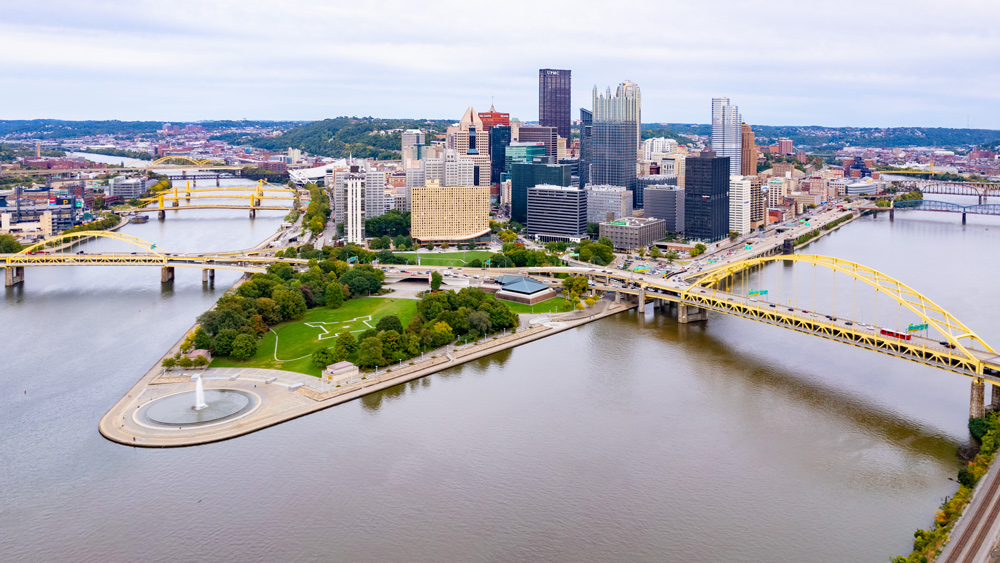
By Wikimedia Commons user Popscreenshot. Other uses must conform to the Create Commons Attribution-ShareAlike 4.0 International.
Pittsburgh is situated at the conflux of the rivers Monongahela and Alleghany, the uniting of which forms the Ohio. The even soil upon which it is built is not more than forty or fifty acres in extent. It is in the form of an angle, the three sides of which are enclosed either by the bed of the two rivers or by stupendous mountains. The houses are principally brick, they are computed to be about four hundred, most of which are built upon the Monongahela; that side is considered the most commercial part of the town. As a great number of the houses are separated from each other by large spaces, the whole surface of the angle is completely taken up.
—François André Michaux[1]François André Michaux, Travels to the West of the Alleghany Mountains (1805 reprint from London edition), p. 58–9 in Reuben G. Thwaites, Travels West of the Alleghanies (Cleveland: The Arthur H. … Continue reading
François André Michaux (1770-1855) should not be confused with his father André Michaux (1746–1802) whom Thomas Jefferson on behalf of the American Philosophical Society asked to lead a Western Expedition to the Pacific Ocean. Both were influential naturalists and both wrote about their travels in America. The younger’s writings show a keen interest in the prospects of the Ohio River Valley and its inhabitants. Later, he would publish his Histoire des Arbres forestiers de l’Amérique Septentrionale in three volumes between 1810 and 1813. It was translated into several English editions usually titled The North America Sylva. Thomas Nuttall completed the series with his volume North American Sylva: Trees not described by F. A. Michaux.[2]Thwaites, Travels, 15,19.
Experience the Lewis and Clark Trail
The Lewis and Clark Trail Experience—our sister site at lewisandclark.travel—connects the world to people and places on the Lewis and Clark Trail.
Plan a trip related to August 2, 1803: