At Wood River across from the mouth of the Missouri, the temperature hovers near the freezing mark with clouds and rain. President Jefferson and others have asked the captains to answer to questions about the religious practices of the Native Nations they will encounter.
Weather Diary
Therm at rise
weather wind Therm at 4 Oclk weather wind River 28 above 0 cloudy S.E. 30 above 0 rain after clouds SSE. rise 1 ft. 2 ½ in. —Meriwether Lewis[1]To assist the reader, the editor of this web page has omitted the “day of month 1804” column, merged the “River” columns, and spelled out some abbreviations.
Questions About Religious Practices
Inquiries relitive to the Indians of Louisiania.
. . . .
3rd. Relative to Religion
What affinity is there between their religious ceremonies and those of the ancient Jews?
Do they use animal sacrifises in their worship?
What are the principal objects of their worship?
Do they Consider Mannatoe or the good Spirit & Michimannatoe or the bad Spirit as two distinct powers, neither having power of Controling the other?
—William Clark[2]Undated and unsigned list written in Clark’s hand. Donald Jackson, ed. Letters of the Lewis and Clark Expedition with Related Documents: 1783-1854, 2nd ed. Urbana: University of Illinois Press, … Continue reading
Synopsis of Indian Hieroglyphics (Detail)
Henry Schoolcraft (1851)
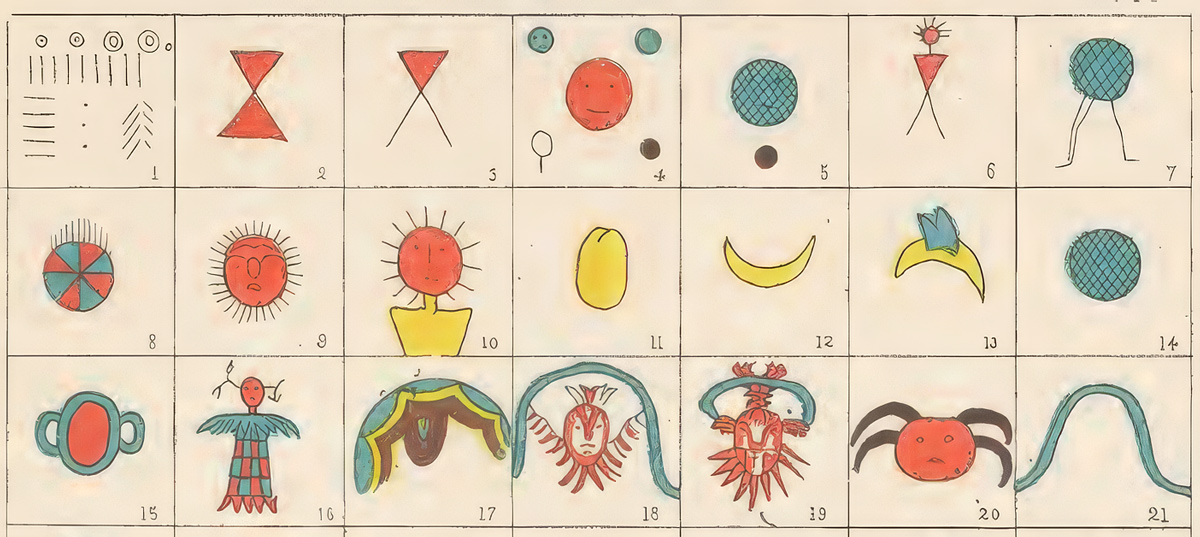
Schoolcraft, Historical and Statistical Information Respecting the History, Plate 58.
In 1847 under the direction of the Bureau of Indian Affairs, Henry R. Schoolcraft, published a multi-volume work describing the North American Tribes. In the first volume, he inventories various devices used in picture writing, primarily from the tribes residing in the Ohio and Lake Superior regions. Regarding drawings on trees, he writes:
The practice of the North American tribes, of drawing figures and pictures on skins, trees, and various other substances, has been noticed by travellers and writers from the earliest times. Often these devices are cut, or drawn in colors, on the trunks of trees, more rarely on rocks or boulders . . . .
In the above figure, Schoolcraft provides the following key:
Number 1: Chronological and arithmetical devices.
Number 2: Symbol of a headless body
Number 3: Symbol of a headless body.
Number 4. Devices representing the human head.
Number 5. Death’s head—symbolically eclipsed, or veiled.
Number 6. The human figure—representative.
Number 7. Symbol of a man walking at night or under the moon.
Number 8: Symbol of the sun.
Number 9: [Symbol of the sun.]
Number 10: A spirit, or man enlightened from on high, having the head of the sun.
Number 11. Totemic mark of the sun.
Number 12. The moon—dry quarter.
Number 13. The moon—flaming.
Number 14. The moon—eclipsed, or at night.
Number 15. A man’s head, with ears open to conviction.
Number 16: A winged female.
Number 17. Clouds.
Number 18. The sun filling the world.
Number 19. A Meda—endowed by the sun with mystic power, denoted by the appended plumes and rays.
Number 20. A Wabeno.
Number 21. The sky.[3]Henry R. Schoolcraft, Historical and Statistical Information Respecting the History, Condition and Prospects of the Indian Tribes of the United States (Philadelphia: Lippincott, Grambo & Company, … Continue reading
Experience the Lewis and Clark Trail
The Lewis and Clark Trail Experience—our sister site at lewisandclark.travel—connects the world to people and places on the Lewis and Clark Trail.
Plan a trip related to February 16, 1804:


Winter Camp at Wood River (Camp Dubois) is a High Potential Historic Site along the Lewis and Clark National Historic Trail managed by the U.S. National Park Service. The site, near Hartford, Illinois, is managed as Lewis and Clark State Historic Site and is open to the public.
Notes
| ↑1 | To assist the reader, the editor of this web page has omitted the “day of month 1804” column, merged the “River” columns, and spelled out some abbreviations. |
|---|---|
| ↑2 | Undated and unsigned list written in Clark’s hand. Donald Jackson, ed. Letters of the Lewis and Clark Expedition with Related Documents: 1783-1854, 2nd ed. Urbana: University of Illinois Press, 1978), 158. |
| ↑3 | Henry R. Schoolcraft, Historical and Statistical Information Respecting the History, Condition and Prospects of the Indian Tribes of the United States (Philadelphia: Lippincott, Grambo & Company, 1851), 1:407–08. |