News of the expedition’s return to St. Louis reaches Philadelphia as printed in The United States Gazette. The paper reprints an extract of a letter written in St. Charles, and in a second article, the paper describes the celebrations in St. Louis.
News Reaches Philadelphia
Old Lutheran Church (1800)
Fifth Street, Philadelphia
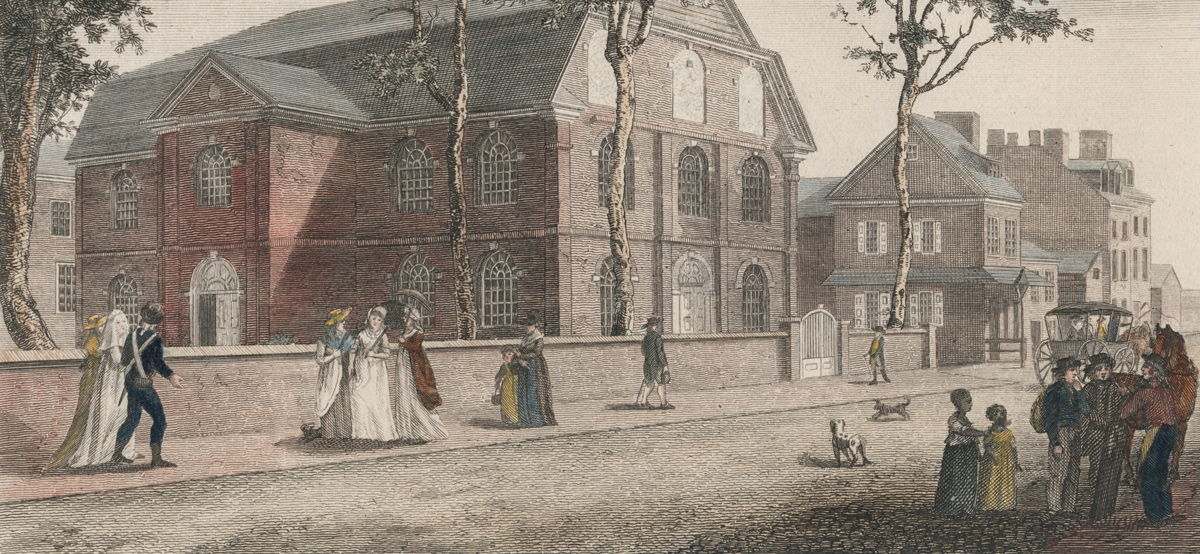
The Miriam and Ira D. Wallach Division of Art, Prints and Photographs, New York Public Library Digital Collections, digitalcollections.nypl.org/items/e5f54f60-c608-012f-41f2-58d385a7bc34.
PHILADELPHIA,
MONDAY, NOVEMBER 10, 1806.. . . . .
More Wonders;—The following extract of a letter is copied from the National Intelligencer. The Rocky mountain sheep [bighorn sheep] beats the horned frog [short-horned lizard] all hollow.
Extract of a letter from a gentleman at St. Charles, to a gentleman in this town dated 23d September 1806.
I have the pleasure to inform you of the arrival of captains Lewis and Clark.
They were the first white people that ever visited that country. By the best accounts they could get, there are about ninety or one hundred thousand inhabitants, (Indians) on the west side of the Rocky Mountains; horses without number. It is thought to be a very poor Indian that did not own 300 horses. Not an iron tool among them. They erected a fort on the sea shore, and engraved their names. They have brought a number of curiosities; among which is a wild sheep; its head and horns weigh about 80 or 90 pounds. He was caught on the Rocky Mountains.[1]The United States Gazette, Philadelphia, 10 November 1806, page 1.
News from St. Louis
Arrival of Captains Lewis and Clark At St. Louis
This desirable and unexpected event, took place on Tuesday, the 23rd of this instant, about the hour of 10 o’clock in the morning. On Monday evening the news reached this place, that Captains Lewis and Clark had arrived at the cantonment; near the mouth of the Missouri; and the great concourse of people that lined the bank of the river at the time of their landing at this place the next day, must be considered as a strong evidence of the respect entertained of those gentlemen for the danger and difficulties they must have encountered in their expedition of discovery.
The following were the Toasts drank at the Dinner:
- The president of the United States—The friend of science, the polar star of discovery, the philosopher and the patriot.
- The Heads of Department—The pillars that support the world’s best hope.
After Capts. Lewis and Clark retired:
- Captains Lewis and Clark—Their perilous services endear them to every American heart.[2]Ibid., page 4.
Experience the Lewis and Clark Trail
The Lewis and Clark Trail Experience—our sister site at lewisandclark.travel—connects the world to people and places on the Lewis and Clark Trail.
Discover More
- The Lewis and Clark Expedition: Day by Day by Gary E. Moulton (University of Nebraska Press, 2018). The story in prose, 14 May 1804–23 September 1806.
- The Lewis and Clark Journals: An American Epic of Discovery (abridged) by Gary E. Moulton (University of Nebraska Press, 2003). Selected journal excerpts, 14 May 1804–23 September 1806.
- The Lewis and Clark Journals. by Gary E. Moulton (University of Nebraska Press, 1983–2001). The complete story in 13 volumes.
This site is provided as a public service by the

Lewis and Clark Trail Alliance
with additional funding from the following: